
The Loudmouth with a Heart of Gold
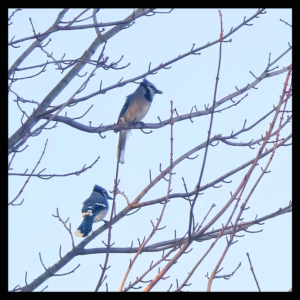
If you’ve spent any time watching birds, you’ve got an opinion about Blue Jays. People either love them or think they’re aggressive bullies who chase off “nicer” birds. I’m firmly in the love camp, and not just because I’ve got Bogart and Bacall visiting my feeders every morning.
Blue Jays are intelligent, loyal, and surprisingly gentle once you get to know them. Yes, they’re loud. Yes, they’ll clear a feeder when they arrive. But they’re also devoted parents, clever problem-solvers, and one of the few corvids (crow family) you’ll see regularly at backyard feeders. They cache thousands of acorns every fall, essentially planting oak forests whether they mean to or not. They warn the whole neighborhood when predators show up.
And they mate for life.
Bogart and Bacall have been coming to Haven since October. I can tell them apart now – Bogart has a slightly larger crest and bolder white markings on his wings, Bacall is a touch smaller and more cautious. They arrive together every morning around 7:30, Bogart announcing their presence with that distinctive JAY-JAY call, Bacall waiting in the willow until he’s checked that it’s safe.
Let’s talk about how to identify Blue Jays, what they’re actually doing at your feeders, and why they deserve more credit than they get.
WHAT IS A BLUE JAY?
Scientific Name: Cyanocitta cristata
Family: Corvidae (crows, ravens, magpies, jays)
Size: 9-12 inches long, 13-17 inch wingspan
Weight: 2.5-3.5 ounces
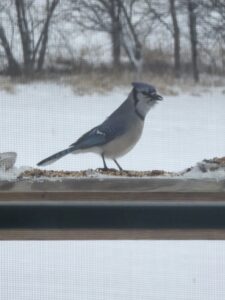
Blue Jays are medium-sized songbirds native to eastern North America, found from southern Canada through the eastern United States. They’re non-migratory in most of their range, though northern populations sometimes move south in winter. They’re corvids, which means they’re in the same family as crows and ravens – and they’ve got the intelligence to match.
What They Look Like:
- Bright blue upper parts with black barring on wings and tail
- White or pale gray underside
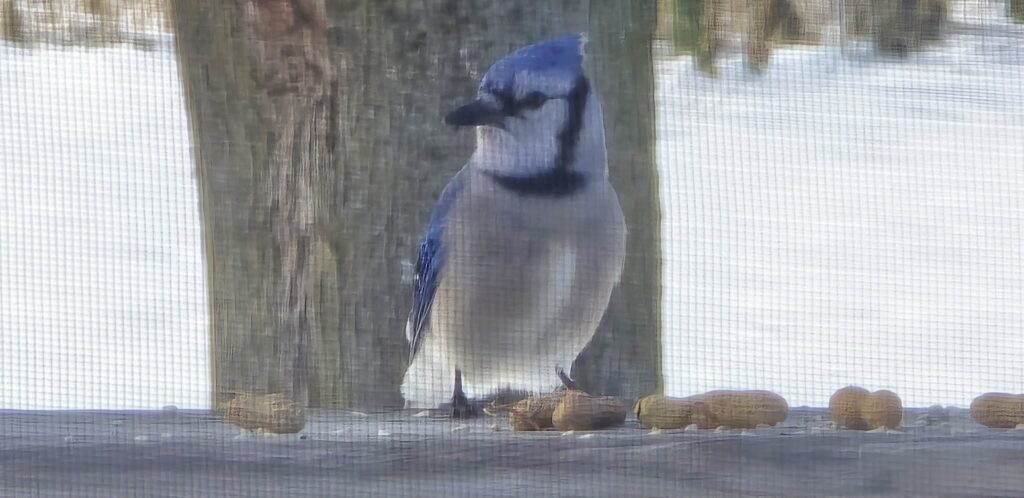
- Black “necklace” across the throat and up around the face
- Prominent blue crest that raises and lowers depending on mood
- White patches on wings and tail (especially visible in flight)
- Black bill, legs, and feet
- White face with black eye stripe extending from bill back past the eye
The Signature Feature:
That brilliant blue color with black and white wing bars. When they fly, those white spots on the wings and outer tail feathers flash – it’s unmistakable.
IDENTIFICATION
THE COLORING:
- Blue isn’t actually a pigment in their feathers – it’s structural color (light refraction)
- Upper parts: bright blue with black barring
- Underside: white to pale gray
- Black “necklace” encircles throat and curves up around face
- White face with black eye line
- Males and females look identical (monomorphic)
THE CREST:
- Pointed crest on top of head
- Raises when bird is excited, aggressive, or alarmed
- Flattens when bird is relaxed or feeding
- Watching Bogart’s crest is like reading his mood – fully raised means he’s spotted something interesting (or threatening), flat means he’s comfortable
THE CALL:
- Loud, harsh “JAY-JAY-JAY” – their signature alarm call
- Also makes a musical “quedle-quedle” sound between mates
- Can mimic hawk calls (Red-shouldered and Red-tailed Hawks especially)
- Makes a variety of soft clicks, rattles, and whistles when relaxed
- Bacall makes this soft trill when she’s talking to Bogart that I never hear her use otherwise
THE FLIGHT PATTERN:
- Direct, level flight with steady wing beats (not undulating like woodpeckers)
- White wing patches flash with each wing beat
- White outer tail feathers visible from below
- Often flies in small family groups
BEHAVIOR & HABITS
Social Structure:
- Mate for life (monogamous pairs)
- Stay together year-round
- Pairs defend territory together
- Young birds often form loose flocks in fall/winter
- Bogart and Bacall always arrive together – I’ve never seen one without the other
Intelligence:
- Corvid intelligence – they can solve multi-step problems
- Recognize individual humans (yes, they know who fills the feeders)
- Cache thousands of acorns every fall for winter food
- Can count – studies show they can distinguish quantities up to 5-6
- Learn from watching other birds
Caching Behavior:
- Each Blue Jay caches 3,000-5,000 acorns per fall
- Can carry up to 5 acorns at once (3 in crop, 1 in mouth, 1 in throat)
- Remember cache locations for months
- Forgotten caches = oak tree seedlings
- They’re literally reforestation agents
Feeding Habits:
- Omnivorous – acorns, nuts, seeds, insects, occasionally eggs or nestlings
- Prefer peanuts in the shell at feeders
- Will eat suet, sunflower seeds, cracked corn
- Often cache food rather than eating immediately
- Bogart grabs a peanut, Bacall watches for threats, then she takes her turn
Nesting:
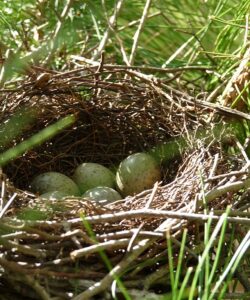
- Build cup nests 10-25 feet up in trees
- Both parents build nest (takes 3-7 days)
- Female incubates 4-5 pale blue-green eggs with brown spots
- Male brings food to female during incubation
- Both parents feed nestlings
- One brood per year (occasionally two in southern range)
THE “BULLY” REPUTATION
Let’s address this head-on: Blue Jays are not bullies.
What people see:
- Blue Jay arrives at feeder
- Smaller birds scatter
- Jay takes peanuts and leaves
- People conclude: “aggressive bully chasing off songbirds”
What’s actually happening:
- Blue Jays are LOUD and LARGE compared to chickadees, finches, sparrows
- Smaller birds scatter because of SIZE difference, not aggression
- Blue Jays rarely actually chase or fight other birds at feeders
- They grab food quickly because THEY’RE nervous too – they’re vulnerable at feeders
The truth:
- Blue Jays are watchful and cautious
- They’re prey animals too (hawks eat them)
- Their loud calls actually WARNING the whole neighborhood about threats
- When Bogart spots the Cooper’s Hawk, he screams bloody murder and every bird within 100 yards takes cover
- They’re the neighborhood alarm system
What I see with Bogart and Bacall:
- They wait their turn if Cardinals or Woodpeckers are at the feeder
- They never chase the smaller birds – the smaller birds just leave because Jays are BIG
- Bogart stands guard while Bacall eats
- They’re cautious, not aggressive
ATTRACTING BLUE JAYS TO YOUR YARD
What They Want:
FOOD:
- Peanuts in the shell (their absolute favorite)
- Sunflower seeds (black oil or striped)
- Suet (especially in winter)
- Cracked corn
- Acorns (if you’ve got oak trees, you’ve got Blue Jays)
FEEDER STYLE:
- Platform feeders or large hopper feeders
- Need space to land and stand (not tiny tube feeders)
- Elevated but with nearby perching spots
- Bogart and Bacall prefer the platform feeder where they can see in all directions
WATER:
- Birdbath with fresh water
- They love to bathe
- Need depth of 2-3 inches
- I see them in the birdbath almost every morning after feeding
HABITAT:
- Oak trees (their natural food source)
- Mixed woodland edge habitat
- Mature trees for nesting
- Brush piles or evergreens for cover
BLUE JAY FACTS THAT MIGHT SURPRISE YOU
- They don’t actually have blue pigment – the blue color is structural (microscopic structures in feathers refract light)
- They plant forests – forgotten acorn caches grow into oak trees
- They’re nest builders, not cavity nesters – unlike woodpeckers or nuthatches
- They can mimic hawks perfectly – sometimes to warn others, sometimes possibly to scare competitors away from food
- They’re monogamous – once paired, they stay together for life
- They mob predators – ganging up to harass hawks, owls, cats, snakes
- They’re one of the few non-tropical birds with bright blue coloring
WATCHING BOGART AND BACALL
I’ve been watching this pair since October, and here’s what I’ve learned:
Their Morning Routine:
- Arrive together around 7:30
- Bogart calls first (loud JAY-JAY-JAY)
- Both land in the willow tree
- Bogart flies to platform feeder first
- Bacall waits until he signals it’s safe
- Bogart grabs a peanut, flies back to willow
- Bacall takes her turn
- They trade off like this for 10-15 minutes
How They Interact:
- Soft trills and clicks between them (completely different from their loud calls)
- Bogart always checks for threats first
- Bacall is more cautious, takes longer to approach
- They cache most of what they take
- If one is missing for more than a day, the other searches and calls
Their Personalities:
- Bogart: Bold, loud, protective. Crest usually raised. First to investigate anything new. Will stand up to the Cardinals.
- Bacall: Cautious, quieter, observant. Watches everything before moving. Softer calls. Waits for Bogart to give the all-clear.
Why I’m grateful for them:
- They warn everyone when the Cooper’s Hawk shows up
- They chase off crows who get too close to the feeders
- Watching their partnership is a daily reminder of loyalty
- They’re planting oak trees all over Haven without even knowing it
WHEN THE HAWKS CAME
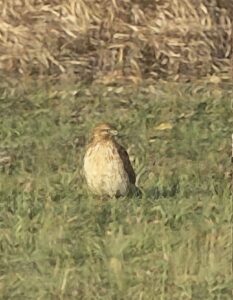
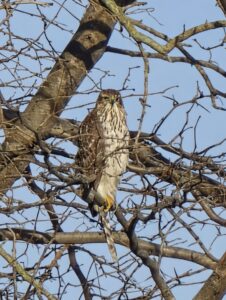
One day, two Cooper’s Hawks were eyeing the feeders from the tree line. No one saw them but me. Then I watched one of the hawks land in the yard about half an acre away, cleaning its beak on the ground. My heart sank.
Even the other birds were freaked out. Ginger was frozen at the side feeder – I walked right up to the window and she didn’t move. She was petrified. I found Fred frozen in the crabapple tree out front. They didn’t want to move even when I walked outside.
So I decided to intervene.
I walked to the property line and spotted the second hawk half an acre away in the opposite direction. The one that had landed was perched in a tree about 40 feet from me. I walked to see how close I could get – ended up standing at the base of the tree, looking Mi’Honor in the eye as she stared back. She gracefully (and what I assumed was annoyedly) flew off slowly. The second hawk did the same.
When I got back to the house, the birds had moved – but Bogart was making a ruckus. Bacall was nowhere to be seen. He was calling and flying all over for thirty minutes. Then she finally showed up and they were chattering away to each other.
Heartwrenching, with a beautiful ending.
FINAL THOUGHTS
Blue Jays get a bad reputation they don’t deserve. They’re not bullies – they’re watchful, intelligent, devoted parents and partners who happen to be loud about it. They’re reforestation agents. They’re the neighborhood watch. They’re beautiful, clever, and once you get to know a pair like Bogart and Bacall, you realize they’ve got distinct personalities and deep bonds.
If you’ve got Blue Jays visiting your yard, consider yourself lucky. Put out some peanuts. Watch how they work together. Listen for the quiet calls they make to each other between the loud alarm calls. You might just fall in love with the loudmouth with a heart of gold.