
The Saffron Imposter
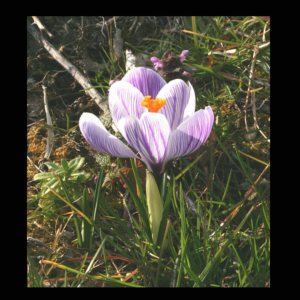
Silvery Crocus is the plant that disappoints saffron hunters. You see purple crocus flowers blooming in early spring and get excited – “Saffron!” you think. Then you look closer and realize: nope, just the striped cousin. No valuable red threads. No culinary gold. Just a pretty spring flower that’s technically edible but not particularly exciting.
It’s safe. It’s harmless. It’s just not what you were hoping for.
But here’s why you should still learn to identify it: because knowing what it ISN’T (saffron, or worse – toxic autumn crocus) is just as important as knowing what it IS.
WHAT IS SILVERY CROCUS?
Botanical Name: Crocus biflorus
Also Known As: Striped Crocus, Scotch Crocus, Two-Flowered Crocus
Family: Iridaceae (Iris family)
Silvery Crocus is a true crocus – member of the Crocus genus, same family as Saffron Crocus. It’s native to southeastern Europe and Turkey but naturalized in some parts of North America, often escaping from gardens.
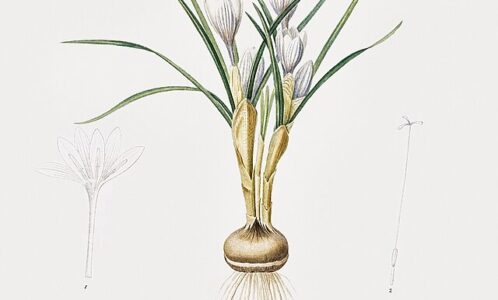
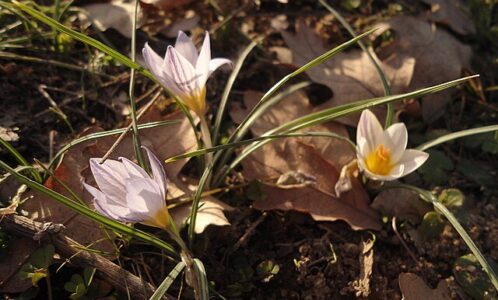
What It Looks Like:
- Small spring-blooming crocus
- 3-5 inches tall
- Cup-shaped flowers
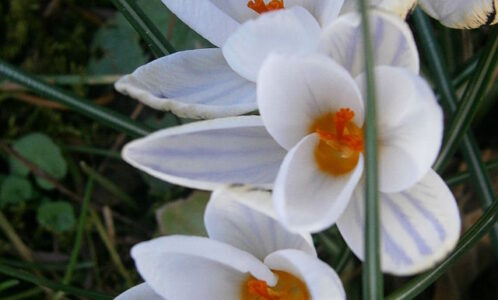
- White to pale lilac/purple petals
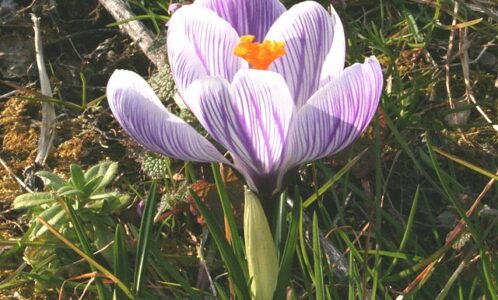
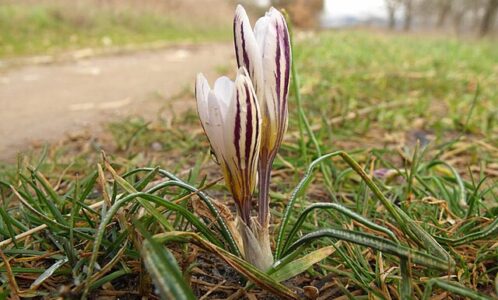
- Distinctive PURPLE STRIPES on outer petals (3-5 stripes)
- Blooms late winter to early spring
The Key Feature:
Those dark purple stripes on the OUTSIDE of the three outer petals. They look like racing stripes or painted lines. This is your visual identifier.
IDENTIFICATION: THE SAFFRON COMPARISON
Since most people encounter Silvery Crocus while looking for Saffron, let’s compare them directly:
| Feature | SILVERY CROCUS | SAFFRON CROCUS |
|---|---|---|
| Stamens | 3 yellow stamens | 3 yellow stamens |
| Stigmas | Short, yellow to orange | LONG, vivid crimson red |
| Petal color | White to pale lilac | Purple, violet, lilac |
| Petal pattern | PURPLE STRIPES on outer petals | Solid color, no stripes |
| Bloom time | Late winter/early spring | Late fall (October-November) |
| Leaves | Present with flower | Present with flower |
| Value | Ornamental only | Culinary/medicinal (expensive) |
| Edibility | Technically edible (corms), not worthwhile | Stigmas are saffron spice |
The Giveaway:
- Timing – Silvery Crocus blooms in SPRING. Saffron blooms in FALL.
- Stripes – Silvery Crocus has purple stripes. Saffron is solid colored.
- Red threads – Saffron has long crimson threads. Silvery Crocus has short yellow/orange stigmas.
If you see purple-striped crocus in spring, it’s not Saffron. It’s Silvery Crocus.
THE THREE-STAMEN RULE
Here’s why Silvery Crocus is actually useful for learning plant identification:
Safe Crocus species (including Silvery and Saffron) have:
- 3 stamens (yellow “legs” inside the flower)
- 3 stigmas (reproductive parts)
- Cup-shaped flowers
- Grass-like leaves
Deadly look-alikes (Autumn Crocus/Colchicum) have:
- 6 stamens
- Often bloom without leaves (“naked ladies”)
- Contain colchicine (fatal poison)
So Silvery Crocus teaches you the counting rule: 3 stamens = safe Crocus. 6 stamens = toxic Colchicum.
This is valuable practice for when you’re hunting the more valuable (and more dangerous to misidentify) Saffron Crocus.
See the full comparison: Deadly Doubles: The Crimson Thread Trap
WHERE SILVERY CROCUS GROWS
Habitat:
- Gardens (often planted ornamentally)
- Naturalized in lawns and meadows
- Well-drained soil
- Full sun to partial shade
- Often escapes cultivation
Season:
- Late winter to early spring
- One of the earliest spring bloomers
- Often blooms while snow is still on the ground
- February-April depending on climate
Distribution:
- Native to southeastern Europe, Turkey
- Naturalized in parts of North America and Europe
- Common garden plant
Growing Conditions:
- Hardy perennial (zones 3-8)
- Grows from corms (underground bulb-like structures)
- Multiplies slowly over time
- Deer resistant
IS IT EDIBLE?
Technically: Yes. Practically: Why bother?
The corms (underground storage structures) of Silvery Crocus are edible and were historically eaten in times of famine in parts of Europe.
Reality check:
- Corms are TINY (size of a large marble)
- Labor-intensive to harvest
- Must be cooked (raw starches are indigestible)
- Minimal caloric value
- Bland, slightly nutty flavor
- Takes a LOT of corms to make a meal
Historical preparation:
- Roasted in coals or ashes
- Boiled until soft
- Eaten as starchy emergency food
- NOT a choice food, more of a “last resort” option
Modern perspective:
Unless you’re in a genuine survival situation, there’s no good reason to dig up crocus corms. They’re small, finicky to process, and not particularly nutritious or tasty. You’d burn more calories harvesting them than you’d gain eating them.
Bottom line: Edible ≠ worth eating.
THE STIGMAS: NOT SAFFRON
The short yellow-to-orange stigmas inside Silvery Crocus flowers are NOT saffron and have no culinary or medicinal value.
Why they’re useless:
- Too short to harvest efficiently
- Wrong color (saffron is crimson red)
- Lack the flavor compounds (safranal, picrocrocin)
- No medicinal properties
- No value as spice or dye
Historic use:
Some sources mention using large quantities of these stigmas to make a weak yellow dye. But it takes hundreds of flowers for minimal color payoff. Not practical.
The takeaway: If you want saffron, you need Saffron Crocus (Crocus sativus). Silvery Crocus is not a substitute.
USES (OR LACK THEREOF)
What Silvery Crocus IS good for:
- Ornamental beauty – It’s a pretty spring flower. That’s the main value.
- Early pollinator food – Bees appreciate the early nectar source when little else is blooming.
- Education – Teaching people to identify true Crocus vs. toxic look-alikes.
- Naturalizing – Makes pretty drifts in lawns and meadows with minimal care.
What it’s NOT good for:
- Culinary use (no flavor)
- Medicine (no active compounds of value)
- Foraging (too small, too much work)
- Saffron substitute (completely different)
GROWING SILVERY CROCUS
If you want to grow it ornamentally:
Planting:
- Plant corms in fall (September-October)
- 3-4 inches deep
- 3-4 inches apart
- Well-drained soil
- Full sun to partial shade
Care:
- Minimal care needed once established
- Let foliage die back naturally after blooming
- Corms multiply slowly
- Deer and rodent resistant (usually)
Blooming:
- One of the first spring bloomers
- Flowers last 1-2 weeks
- Closes at night and in cloudy weather
- Naturalizes over time to form drifts
THE LOOK-ALIKE WARNING
Silvery Crocus can be confused with other spring bulbs. Here’s what to check:
Safe Look-Alikes:
- Other Crocus species (all safe, 3 stamens)
- Iris reticulata (dwarf iris, also safe, different flower structure)
The One to Worry About:
- Autumn Crocus / Colchicum (Colchicum autumnale) – HIGHLY TOXIC
How to tell them apart:
| Feature | SILVERY CROCUS | AUTUMN CROCUS |
|---|---|---|
| Stamens | 3 | 6 |
| Leaves when flowering | Present | Usually absent (“naked”) |
| Bloom time | Spring | Fall |
| Toxicity | Safe | FATAL (contains colchicine) |
The key test: Count the stamens. 3 = safe. 6 = toxic.
But also: Silvery Crocus blooms in SPRING with leaves. Autumn Crocus blooms in FALL without leaves.
See: Deadly Doubles: The Crimson Thread Trap for full comparison
WHY BOTHER LEARNING THIS PLANT?
Good question. If it’s not edible, not medicinal, and not saffron, why care?
Reasons to know Silvery Crocus:
- It teaches you the 3-stamen rule – critical for identifying safe Crocus vs. toxic Colchicum
- It prevents disappointment – you won’t waste time thinking you found saffron
- It’s common – you’re likely to encounter it, especially in old gardens and naturalized areas
- It’s pretty – knowing the name of a beautiful spring flower is its own reward
- It’s safe – knowing what’s NOT toxic is valuable information
THE REALITY CHECK
Silvery Crocus is the botanical equivalent of “thanks, but no thanks.” It’s:
- Safe (good!)
- Pretty (nice!)
- Edible in theory (technically true!)
- Completely useless in practice (also true!)
It’s the plant you learn about so you don’t confuse it with something valuable (Saffron) or something deadly (Autumn Crocus).
My advice:
- Learn to identify it (especially those purple stripes)
- Appreciate it blooming in late winter when little else is flowering
- Don’t bother harvesting it
- Move on looking for more useful plants
It’s a plant identification teaching tool that happens to be pretty. That’s its role. Accept it for what it is.
FINAL THOUGHTS
Not every plant needs to be useful to be worth knowing. Silvery Crocus serves its purpose: it’s a safe, identifiable spring flower that teaches you important identification skills (counting stamens, recognizing true Crocus) without any risk.
Is it exciting? No. Is it valuable? Not really. Is it worth learning? Yes – because learning what something ISN’T is often just as important as learning what it IS.
Plus, after a long winter, those purple-striped flowers pushing through the last snow are genuinely beautiful. Sometimes that’s enough.
Just don’t try to make saffron from it. That way lies disappointment.
For saffron identification, see Saffron Crocus. For toxic look-alikes, see Deadly Doubles: The Crimson Thread Trap. For other spring plants, see the Flora Archive.