
The Misunderstood Hunter
Cooper’s Hawks get a bad reputation. People see them at their feeders and panic – “a hawk is killing my birds!” They’re called aggressive, destructive, unwanted. Bird forums are full of posts asking how to “get rid of” Cooper’s Hawks.
But here’s the truth: Cooper’s Hawks are native predators doing exactly what they’re supposed to do. They’re not villains. They’re skilled hunters maintaining the balance of bird populations, removing sick and weak individuals, keeping species healthy. They were here long before we put up feeders.
And if you’re lucky enough to earn their trust – if one chooses your land as part of their territory – you’re witnessing one of North America’s most impressive aerial hunters up close.
Mi’Honor is a Cooper’s Hawk who shares Haven with me. She’s taught me more about patience, respect, and the reality of wild predators than any book ever could. She’s not my hawk – she’s her own sovereign – but it’s my honor to share this land with her.
Let’s talk about what Cooper’s Hawks actually are, how to identify them, and why they deserve our respect instead of our fear.
WHAT IS A COOPER’S HAWK?
Scientific Name: Accipiter cooperii
Family: Accipitridae (hawks, eagles, kites)
Size: 14-20 inches long, 24-35 inch wingspan
Weight: Males 7.8-14.5 oz, Females 11.6-24 oz (females significantly larger)
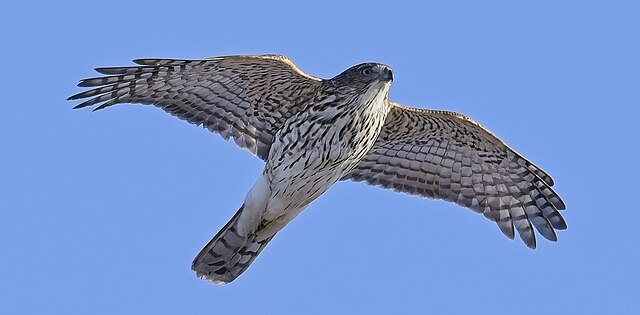
Cooper’s Hawks are medium-sized hawks native to North America, found throughout the continental United States and southern Canada. They’re woodland hawks – built for speed and maneuverability through dense forest. They’re accipiters, which means they’re specialists at hunting other birds.
What They Look Like:
Adults:
- Blue-gray back and wings
- Rusty or orange horizontal barring on white/cream breast
- Dark cap on head (appears hooded)
- Red or orange eyes
- Long tail with dark bands and white tip
- Yellow legs and feet
- Hooked beak
Juveniles/Immatures (first year):
- Brown back and wings
- Vertical brown streaking on white/cream breast
- Yellow eyes (turn orange/red with age)
- Same long tail with dark bands
- Often bulkier-looking than adults
The Signature Features:
- Long, rudder-like tail (longer than Sharp-shinned Hawk, their smaller cousin)
- Rounded tail tip (Sharp-shinned has square or notched tail)
- Barrel-chested appearance in flight
- Flap-flap-glide flight pattern
IDENTIFICATION
SIZE & SEXUAL DIMORPHISM:
Cooper’s Hawks show dramatic size difference between sexes – females are about 1/3 larger than males. This is one of the most extreme size differences in North American raptors.
- Males: 14-16 inches, smaller and more agile
- Females: 16-20 inches, larger and more powerful (better at taking bigger prey)
If you see a Cooper’s Hawk that looks massive and stocky, it’s probably a female. If it looks sleeker and smaller, probably a male.
THE COLORING:
Adults:
- Slate blue-gray back
- Rusty-orange horizontal barring on breast (looks like a vest)
- White undertail coverts (the fluffy feathers under the tail)
- Dark cap creating a “hooded” look
- Red to orange eyes
Juveniles:
- Brown back with white edging on feathers
- Heavy brown streaking on white breast (vertical, not horizontal)
- Yellow eyes
- Brown and white banded tail
My’Honor appears to be an adult female based on her size, the heavy barring on her breast, and her behavior (the more dominant hunter).
THE TAIL:
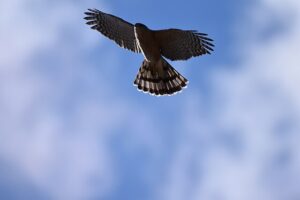
This is THE key field mark for Cooper’s Hawk vs Sharp-shinned Hawk (they look very similar).
Cooper’s Hawk tail:
- LONG (extends well beyond wingtips when perched)
- ROUNDED tip
- Thick dark bands with white terminal band
- When spread, shows rounded shape
Sharp-shinned Hawk tail (for comparison):
- Shorter
- Square or slightly notched tip
- Thinner overall
THE FLIGHT PATTERN:
Cooper’s Hawks have a distinctive flight style:
- Flap-flap-flap-GLIDE
- Quick, stiff wingbeats followed by a glide
- Looks almost mechanical
- Can maneuver through dense woods at high speed
When soaring (riding thermals), they hold wings in a slight dihedral (shallow V-shape) and fan the tail.
BEHAVIOR & HUNTING
Hunting Style:
Cooper’s Hawks are ambush predators specializing in birds. Their hunting method:
- Perch and wait – sit in concealed location near bird activity
- Explosive pursuit – burst from cover at high speed
- Aerial chase – follow prey through obstacles (trees, buildings, etc.)
- Grab mid-flight – snatch birds out of the air with feet
They’re built for this:
- Long tail acts as rudder for tight turns
- Short, rounded wings for quick acceleration
- Powerful feet with sharp talons
- Binocular vision for tracking fast-moving prey
What They Hunt:
Primarily birds, 90% of their diet:
- Mourning Doves (favorite prey)
- European Starlings
- House Sparrows
- American Robins
- Blue Jays
- Occasionally small mammals (chipmunks, squirrels)
Size of prey: Sparrow-sized up to pigeon-sized. Females can take larger prey than males.
Hunting Success Rate: About 20% – most chases fail. This is normal and expected for bird-hunting raptors.
Territory & Behavior:
- Territorial during breeding season
- Often use same hunting areas year after year
- Can become habituated to humans (will hunt near people if food source is reliable)
- Both parents hunt to feed nestlings
- Young birds disperse widely in fall/winter
THE “FEEDER HAWK” REPUTATION
Let’s address this directly, because it’s the biggest point of conflict between Cooper’s Hawks and backyard birders.
What people see:
- Put up bird feeders to attract songbirds
- Cooper’s Hawk shows up
- Hawk catches and eats birds at the feeder
- People get upset: “This hawk is killing MY birds!”
What’s actually happening:
1. You created a hunting ground.
Bird feeders concentrate prey in one location. This is exactly what Cooper’s Hawks look for – high-density food sources. You didn’t attract the hawk directly, but the abundance of birds you created did.
2. The hawk is doing what hawks do.
Cooper’s Hawks are native predators. They evolved alongside these songbird species. They’re supposed to hunt birds. That’s their ecological role.
3. Individual birds vs. populations.
Yes, the hawk will catch individual birds. But Cooper’s Hawks are NOT decimating songbird populations. The species that visit feeders (Cardinals, Jays, Sparrows, Finches) have stable or increasing populations. Habitat loss, window strikes, and domestic cats kill far more birds than Cooper’s Hawks ever will.
4. Natural selection at work.
Hawks tend to catch sick, injured, or less alert birds. This actually benefits the prey population by removing individuals that might spread disease or have genetic weaknesses.
What to do if a Cooper’s Hawk hunts at your feeders:
Option 1: Accept it.
- This is nature
- You’re witnessing an apex predator doing what it evolved to do
- The hawk has as much right to be there as the songbirds
- Consider it part of the show
Option 2: Modify your setup.
- Add dense shrubs/bushes near feeders (escape cover for songbirds)
- Move feeders closer to windows (hawks less likely to strike close to glass)
- Take feeders down for 2-3 weeks (hawk will move to different hunting area)
Option 3: Appreciate both.
- Feed songbirds AND respect the hawk
- Understand you’re supporting the whole ecosystem, not just the “pretty” parts
What NOT to do:
- Don’t harm the hawk (they’re federally protected under the Migratory Bird Treaty Act)
- Don’t relocate the hawk (illegal and doesn’t work – another will move in)
- Don’t blame the hawk for being a hawk
MY EXPERIENCES WITH MI’HONOR
I named her Mi’Honor because it’s my honor to share this land with her. She was here first, or we both chose Haven at the same time. Either way, we’re co-sovereigns of this space.
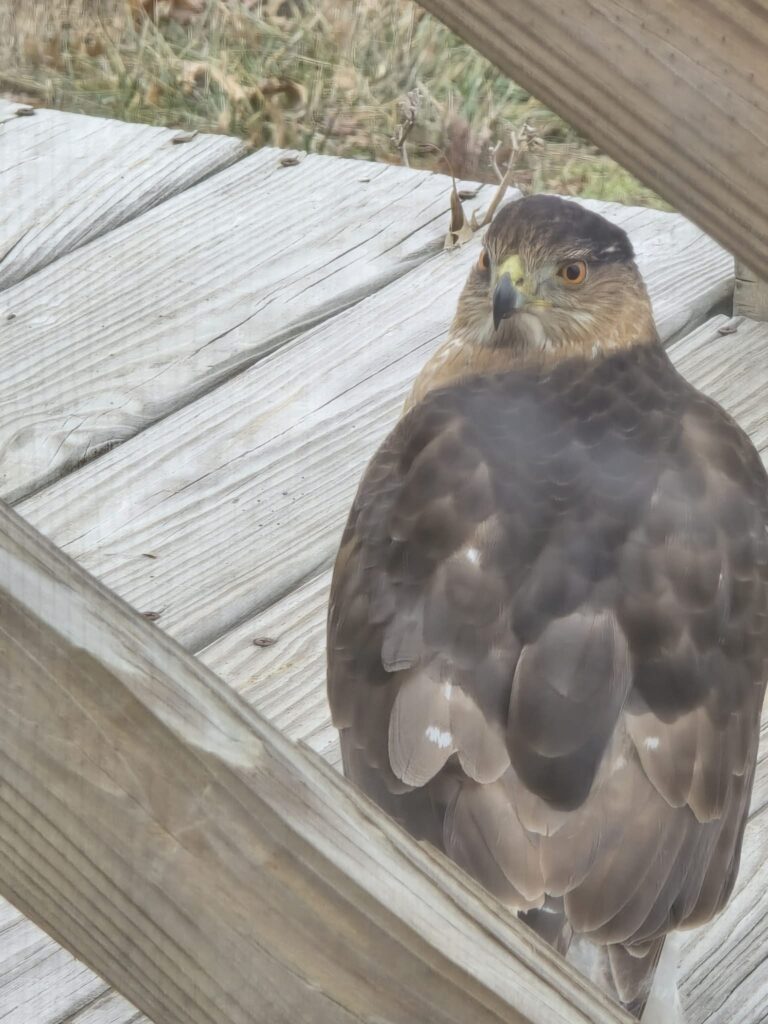
The Day She Landed on My Deck:
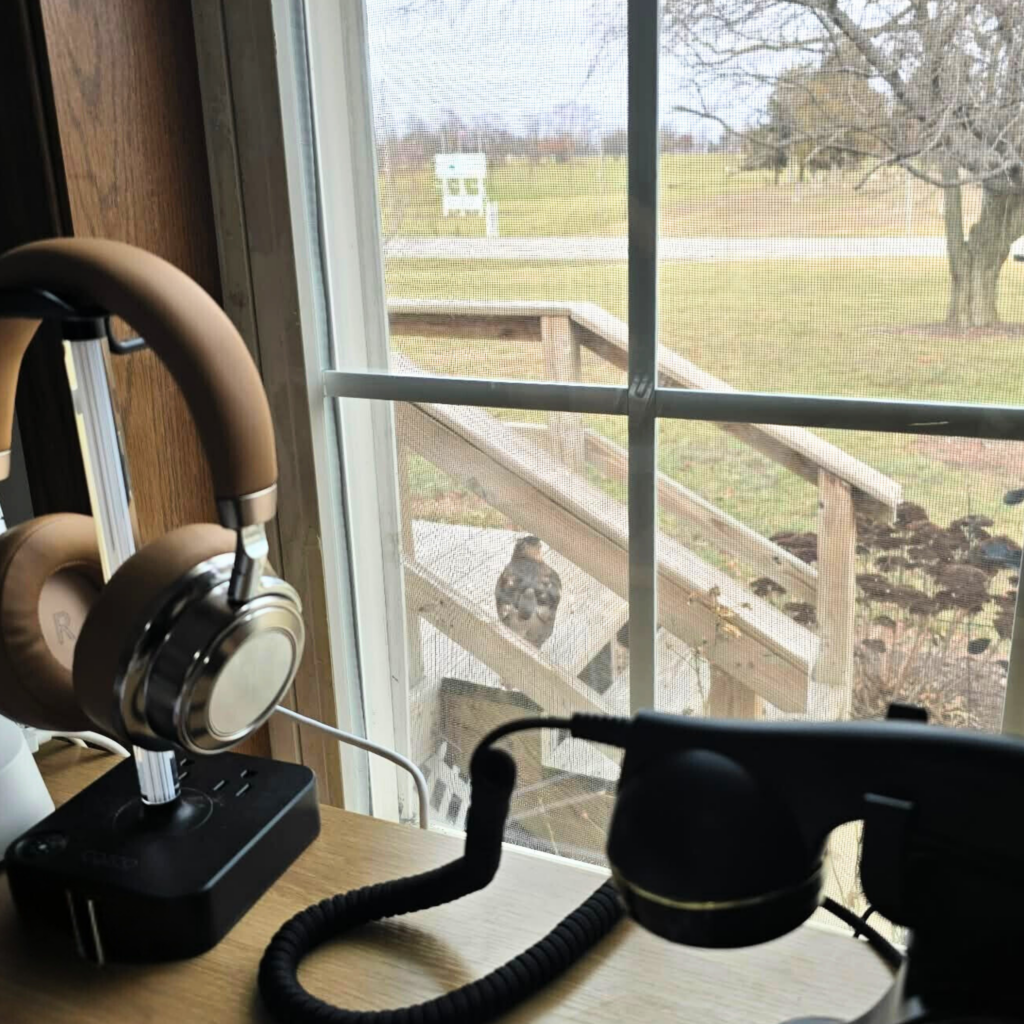
I’d just moved to Haven, barely unpacked, finally able to set up my office and get back to work. I was at my desk – vintage rotary phone beside me, headphones on the stand, looking out at the property through the window.
And she landed right there. On the deck step. Maybe three feet from the window.
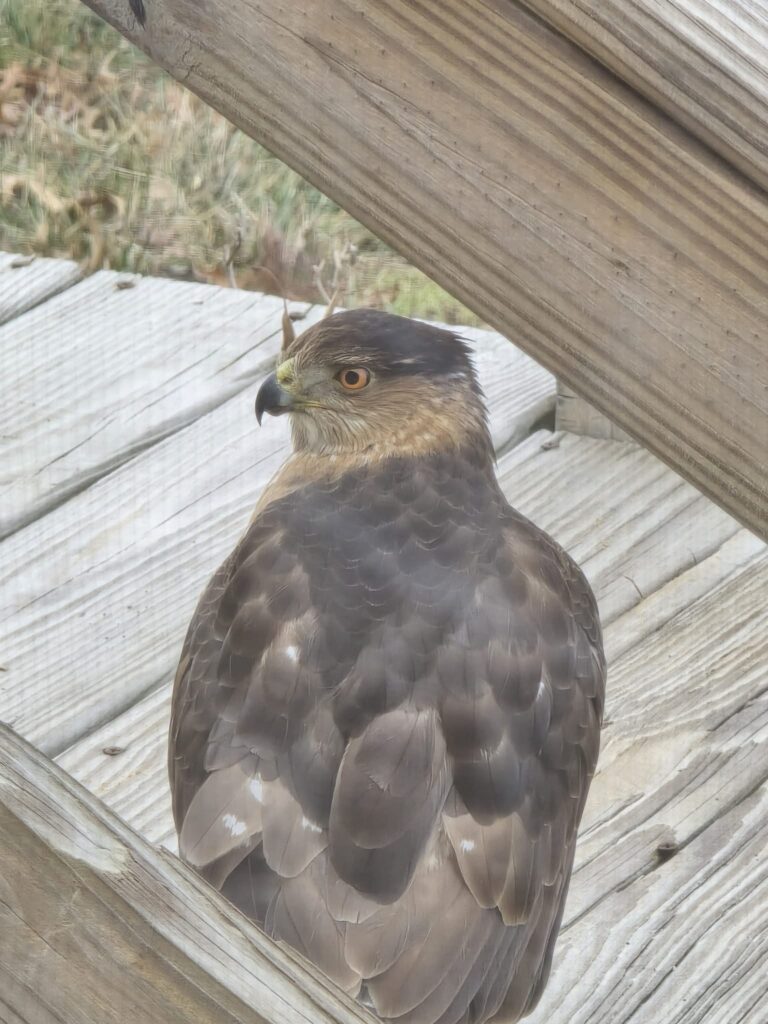
She just… sat. Looked around. Looked at me. Made direct eye contact. Let me grab my phone and take photos – close-up portraits where you can see every detail. The fierce orange eye. The slate-gray back. The rusty barring on her breast. The powerful build of a female Cooper’s Hawk.
She stayed for several minutes. Not hunting. Not eating. Just being present.
It felt like acknowledgment. Like she was saying: “I see you. I know you’re here. We share this space.”
That’s when I knew her name. Mi’Honor.
The Day the Two Hawks Came:
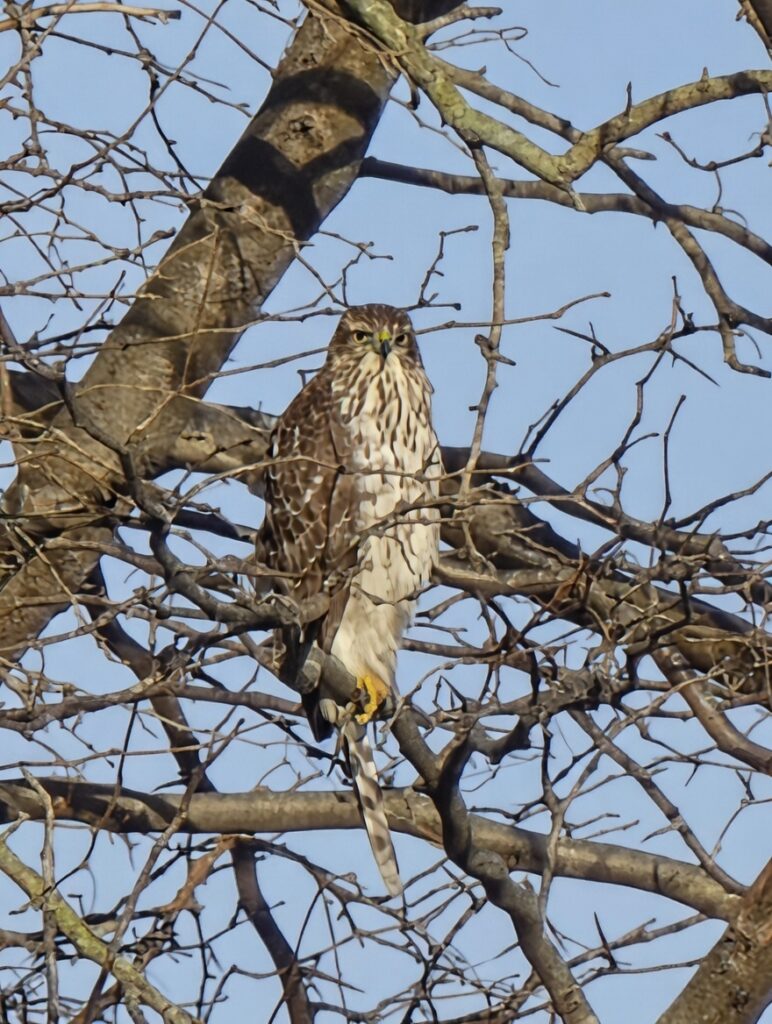
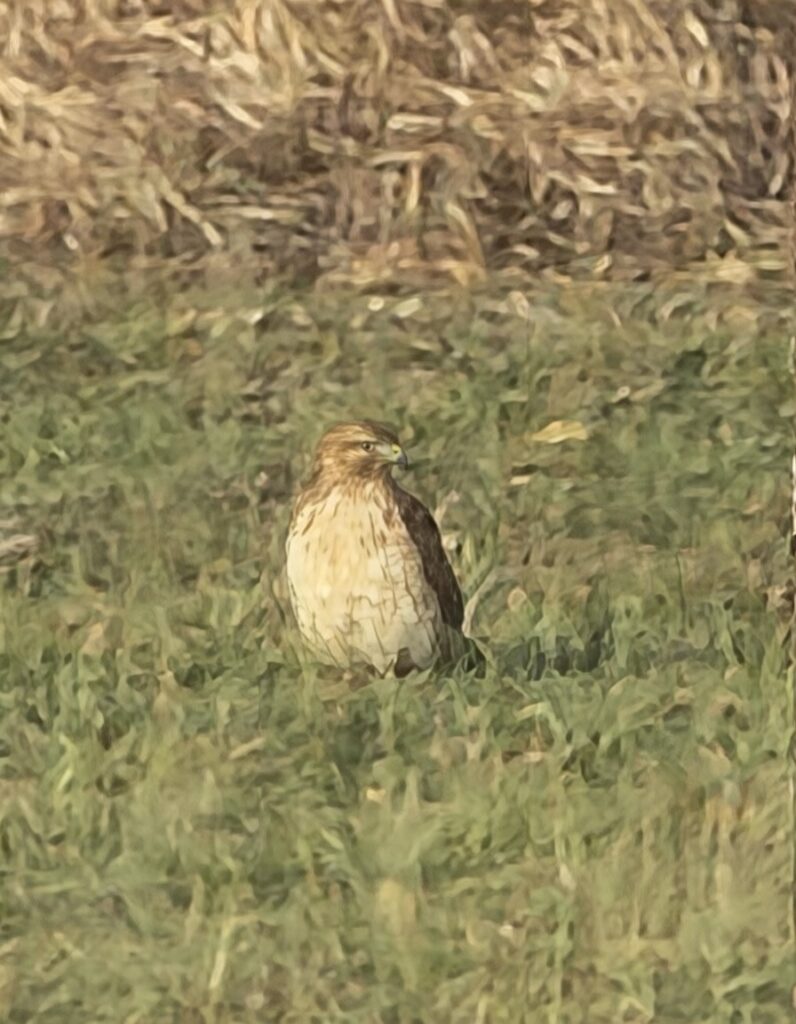
One morning, two Cooper’s Hawks were eyeing the feeders from the tree line. No one saw them but me. Then I watched one land in the yard about half an acre away, cleaning her beak on the ground. My heart sank.
The other birds were freaked out. Ginger (female Cardinal) was frozen at the side feeder – I walked right up to the window and she didn’t move. She was petrified. I found Fred (male Cardinal) frozen in the crabapple tree out front. Even when I walked outside, they didn’t want to move.
So I decided to intervene.
I walked to the property line and saw the second hawk about half an acre away in the opposite direction. The one that had landed was in a tree about 40 feet from me. So I walked to see how close I could get.
I ended up standing at the base of the tree, looking this beauty in the eye as she stared back. She gracefully – and what I assumed was annoyedly – flew off slowly. The second hawk did the same.
When I got back to the house, the birds had moved. But Bogart (male Blue Jay) was making a ruckus. Bacall (female Blue Jay) was nowhere to be seen. He was calling and flying all over for thirty minutes.
Then she finally showed up, and they were chattering away to each other.
Heartwrenching, with a beautiful ending.
What I Learned:
Mi’Honor is a hunter. That’s what she does. But that day, I realized the other birds aren’t just prey to me – they’re individuals I know by name. Fred and Ginger. Bogart and Bacall. Harvey. Little Goldeen Finick.
I can respect Mi’Honor’s right to hunt AND care about the birds she hunts. Both things can be true.
That’s the reality of running a bird sanctuary. You don’t get to choose only the “nice” parts of nature. Predators are part of the ecosystem. Death is part of life. And sometimes you stand at the base of a tree looking a hawk in the eye, asking her – respectfully – to hunt somewhere else today.
She honored that request. She left.
But she came back. Because this is her land too.
ATTRACTING COOPER’S HAWKS (OR NOT)
If You Want to See Cooper’s Hawks:
You don’t attract them directly – you create habitat that attracts their prey, and they follow.
- Bird feeders (concentrates prey)
- Dense cover (allows ambush hunting)
- Mature trees (nesting sites)
- Water sources (birds bathing = vulnerable prey)
If You DON’T Want Cooper’s Hawks Hunting at Your Feeders:
- Remove feeders for 2-3 weeks (hawk will hunt elsewhere)
- Add dense shrubs near feeders (escape cover)
- Space out feeders (don’t concentrate prey)
- Use covered feeders or feeders close to bushes
Remember: You can’t truly “get rid of” Cooper’s Hawks. They’re wild, free, and protected by federal law. The best you can do is make your feeders less appealing as a hunting ground.
COOPER’S HAWK FACTS
- They’re urban adapters – increasingly common in cities and suburbs where prey is abundant
- Monogamous pairs – often mate for life and return to same nesting territory
- Nest builders – build stick platform nests high in trees
- 3-5 eggs per clutch – both parents hunt to feed nestlings
- Juvenile dispersal – young birds wander widely in fall, establishing new territories
- They can live 10-12+ years in the wild
- Pesticide recovery story – populations crashed during DDT era, recovered after ban
- Protected by federal law – Migratory Bird Treaty Act makes it illegal to harm, harass, or kill them
COOPER’S HAWK VS. SHARP-SHINNED HAWK
These two species look very similar. Here’s how to tell them apart:
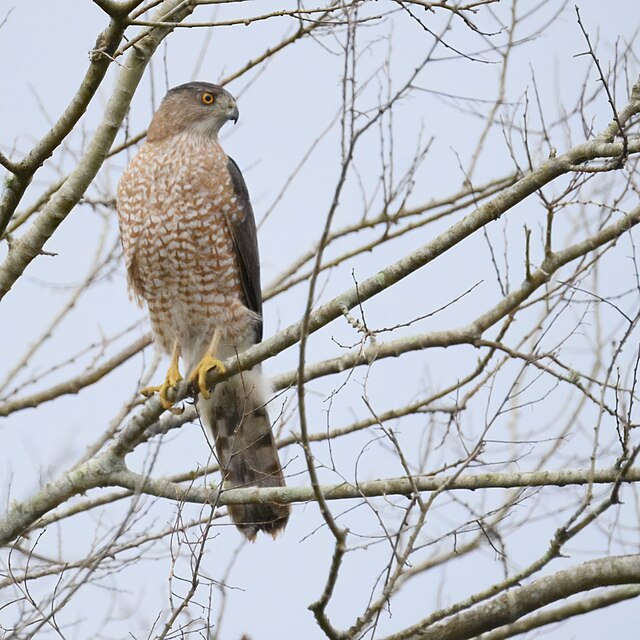
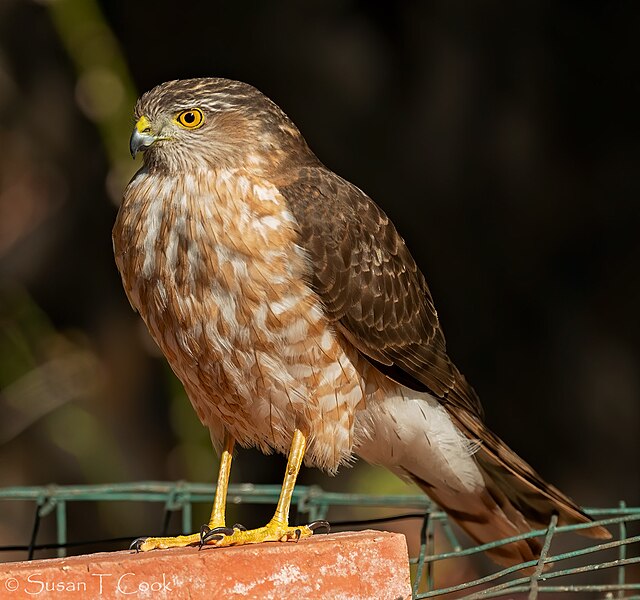
Cooper’s Hawk:
- Larger (crow-sized)
- Longer tail relative to body
- Rounded tail tip
- Larger, blockier head
- Thicker legs
- More barrel-chested in flight
Sharp-shinned Hawk:
- Smaller (jay-sized)
- Shorter tail relative to body
- Square or notched tail tip
- Smaller head (looks “neckless”)
- Thin, pencil-like legs
- More slender overall
Rule of thumb: If it looks big and powerful, it’s probably a Cooper’s. If it looks small and delicate, it’s probably a Sharp-shinned.
FINAL THOUGHTS
Cooper’s Hawks are not villains. They’re not “mean” or “aggressive.” They’re skilled hunters doing exactly what evolution designed them to do. They maintain healthy songbird populations by removing sick and weak individuals. They’ve survived pesticide devastation and recovered. They’ve adapted to human-altered landscapes and thrived.
If a Cooper’s Hawk hunts at your feeders, you’re witnessing something remarkable – an apex predator in action, demonstrating speed, agility, and precision that took millions of years to perfect.
Yes, it’s hard to watch a bird you’ve been feeding get caught. I know – I’ve named mine. But that’s the deal when you invite wild nature into your space. You don’t get to pick and choose which parts show up.
Mi’Honor has taught me this. She hunts here. She perches on my deck. She makes eye contact. She shares this land with me, and I with her.
It’s my honor.
And maybe, on some level, it’s hers too.