
The Brain Mushrooms
⚠️ TOXICITY LEVEL: POTENTIALLY FATAL – Contains gyromitrin (rocket fuel precursor), can cause liver failure
Here’s the problem with False Morels: they look similar enough to True Morels that people confuse them. They grow in the same places, at the same time, and from a distance, they can look like a decent match. Then someone eats them, and things get complicated.
Some people eat False Morels for years without incident. Then one day, the toxin accumulates to a critical level, or that particular mushroom has higher toxin content, or their liver just says “enough,” and they end up in the hospital with organ failure.
This is Russian roulette with fungi. And the house always wins eventually.
WHAT ARE FALSE MORELS?
False Morels are mushrooms in the genus Gyromitra – a group of fungi that superficially resemble True Morels but are significantly different both in appearance and chemistry.
Common species:
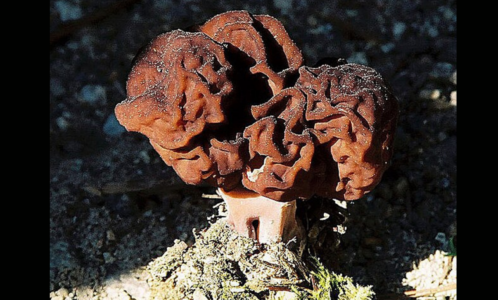
- Gyromitra esculenta – the most common, reddish-brown “brain” cap
- Gyromitra infula – saddle-shaped, often appears in fall
- Gyromitra gigas – large species, sometimes called “snow mushroom”
- Gyromitra caroliniana – found in southeastern US
The species name esculenta means “edible” – which is either ironic or dangerously misleading, depending on your perspective. Europeans historically ate them after extensive preparation. People still die from them.
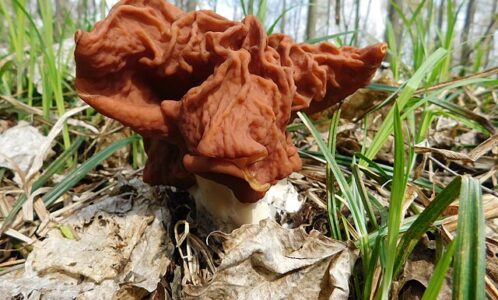
IDENTIFICATION: THE BRAIN SIGNATURE
THE CAP:
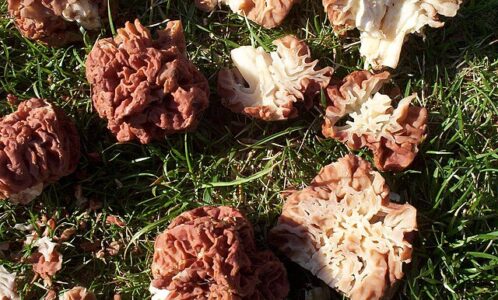
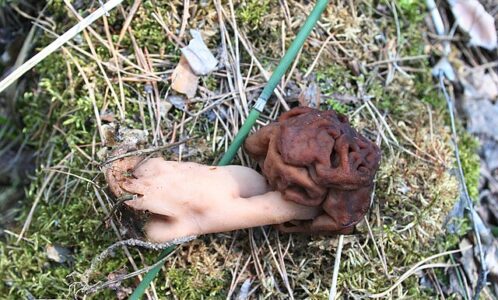
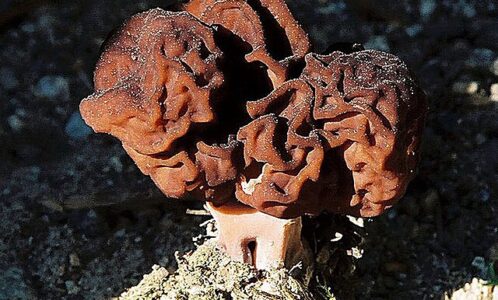
- Brain-like, convoluted, wrinkled appearance – this is the defining feature
- Looks like cerebral tissue or intestines folded on themselves
- NOT honeycomb with organized pits and ridges
- Irregular, wavy, random folds and lobes
- Color: reddish-brown, burgundy, dark brown, sometimes yellowish-brown
- Often wider than it is tall
- Saddle-shaped or irregular lobed shape
- Size: 2-6 inches across (can be larger)
THE STEM:
- White to cream colored
- Thick, often robust
- NOT hollow or only partially hollow
- Interior is chambered, cottony, or irregularly hollow – NOT a single smooth chamber
- The stem may have cotton-like material filling it
- Cap hangs FREE at the bottom edge – there’s a gap between cap and stem, like a wavy skirt
THE INTERIOR (cut lengthwise):
- Cottony, chambered, or partially solid
- NOT one smooth hollow cavity
- May have irregular pockets or chambers
- Often has cotton-like material inside
- This is THE definitive difference from True Morels
THE SMELL:
- Sometimes pleasant and mushroomy
- Sometimes faintly chemical or unpleasant
- Not reliably distinctive
- Don’t rely on smell for identification
THE SPORE PRINT:
- White to cream (but you shouldn’t be getting close enough to need this)
WHERE FALSE MORELS GROW
HABITAT:
False Morels grow in similar places to True Morels, which is why confusion happens:
- Conifer and hardwood forests
- Sandy or disturbed soil
- Near rotting wood
- Old burn sites
- Along roads and trails
- Sometimes in the exact same locations as True Morels
SEASON:
- Spring (April-May, depending on location) – most common
- Fall (September-October) – some species like G. infula
The fact that they can fruit alongside True Morels is what makes them so dangerous.
DISTRIBUTION:
Throughout North America, Europe, and other temperate regions.
THE POISON: GYROMITRIN
False Morels contain gyromitrin, a hydrazone compound that:
- Metabolizes in your body to monomethylhydrazine (MMH)
- MMH is literally rocket fuel (used as rocket propellant)
- Yes, you read that correctly – rocket fuel
- Destroys red blood cells (hemolysis)
- Causes anemia
- Can lead to kidney damage from breakdown products
- Damages the liver
- Acute liver toxicity
- Can progress to liver failure
- May cause permanent liver damage
- Affects the central nervous system
- Can cause seizures
- Neurological effects
- Is cumulative
- Toxin can build up in your body over repeated exposures
- What doesn’t kill you this year might kill you next year
Toxin Levels Vary:
- Different species contain different amounts
- Individual mushrooms vary in toxin content
- Growing conditions affect toxicity
- No way to tell how toxic a particular mushroom is by looking at it
HOW FALSE MOREL POISONING HAPPENS
Scenario 1: Mistaken Identity
Most common. Someone thinks they’re harvesting True Morels. They don’t cut the mushrooms open to check if they’re hollow. They cook and eat them. Hours later, symptoms begin.
Scenario 2: “My Family Has Always Eaten Them”
Someone’s grandparents ate “morels” that were actually Gyromitra. They survived (luck, genetic differences, or lower toxin exposure). The person assumes they’re safe. The toxin accumulates, or this batch is more toxic. Serious poisoning follows.
Scenario 3: “I’ll Parboil Them First”
Someone knows False Morels are toxic but believes the European method of parboiling (boiling and discarding water multiple times) makes them safe. It reduces toxins but doesn’t eliminate them. Plus, they’re breathing toxic fumes while boiling. They get poisoned anyway.
Scenario 4: Raw or Undercooked
Someone eats them raw or undercooked (why?!). The toxin levels are highest in raw mushrooms. Severe poisoning follows.
SYMPTOMS OF GYROMITRA POISONING
Delayed Onset:
Symptoms typically appear 6-24 hours after ingestion (this delay is dangerous because people don’t immediately connect symptoms to mushroom consumption).
Early Symptoms (6-12 hours):
- Nausea and vomiting (often severe)
- Abdominal pain and cramping
- Diarrhea (sometimes bloody)
- Headache
- Dizziness, vertigo
- Feeling of general malaise
Progressive Symptoms (12-24+ hours):
- Jaundice (yellowing of skin and eyes) – indicates liver damage
- Dark urine
- Confusion, delirium
- Seizures (in severe cases)
- Coma
Severe Cases:
- Acute liver failure
- Kidney failure (from hemolysis)
- Death (typically from liver failure or complications)
Timeline to Death:
If fatal, death usually occurs 2-7 days after ingestion from multi-organ failure.
THERE IS NO ANTIDOTE
Treatment for Gyromitra poisoning is supportive only:
- IV fluids for dehydration
- Anti-seizure medications if needed
- Monitoring liver and kidney function
- Dialysis if kidneys fail
- In severe cases: liver transplant may be the only option
- Hope the patient’s liver can recover
The mortality rate is relatively low (fatalities are uncommon) because:
- Severe vomiting often expels much of the toxin
- Modern medical supportive care is effective
- Many people only eat small amounts
But “uncommon” doesn’t mean “never.” People still die from False Morels.
THE “SOME PEOPLE EAT THEM” PROBLEM
You’ll hear this: “Europeans have eaten them for centuries!” or “My family always eats them after parboiling!”
Here’s the complicated truth:
Why Some People Survive:
- Genetic variation – some people metabolize gyromitrin differently
- Toxin variation – some mushrooms have lower toxin content
- Preparation methods – extensive parboiling reduces (but doesn’t eliminate) toxins
- Amount consumed – small amounts may not reach toxic threshold
- Luck – toxin levels vary, and sometimes people get lucky
Why This Doesn’t Make Them Safe:
- Cumulative toxicity – builds up over time
- No way to know toxin level in any given mushroom
- Individual sensitivity varies
- One bad batch can be fatal
- Parboiling creates toxic fumes you’re breathing
- “I haven’t died yet” is not a food safety strategy
The European Practice:
In some parts of Scandinavia and Eastern Europe, people do eat Gyromitra after:
- Multiple changes of boiling water (parboiling)
- Discarding all water
- Extensive cooking afterward
This reduces toxins significantly but doesn’t eliminate them. It’s tradition, not safety. And people still get poisoned.
THE KEY DIFFERENCES FROM TRUE MORELS
| Feature | TRUE MORELS | FALSE MORELS |
|---|---|---|
| Cap texture | Honeycomb – organized pits and ridges | Brain-like – random wrinkles and folds |
| Cap attachment | Attached all around bottom edge | Hangs free at bottom like a skirt |
| Interior | Completely hollow – one chamber | Cottony, chambered, or solid |
| Shape | Conical or rounded, more uniform | Irregular, lobed, saddle-shaped |
| Color | Tan, yellow, gray, black | Reddish-brown, burgundy, brown |
The Definitive Test:
Cut the mushroom in half lengthwise. If it’s completely hollow inside with one smooth chamber, it’s a True Morel. If it has cottony material or irregular chambers, it’s NOT a True Morel and should not be eaten.
WHY PEOPLE STILL EAT THEM (And Why They Shouldn’t)
Arguments people make:
- “My grandfather ate them his whole life”
- “If you prepare them right, they’re safe”
- “Europeans eat them”
- “They’re delicious”
- “I’ve eaten them before and I’m fine”
Why these arguments are bad:
- Toxins accumulate – past survival doesn’t guarantee future safety
- “Preparing them right” reduces but doesn’t eliminate toxins
- European tradition includes poisonings and deaths too
- There are plenty of delicious, non-toxic mushrooms
- Cumulative toxicity means “I’m fine” might not last
The risk-reward calculation:
- Risk: Liver failure, kidney failure, death
- Reward: A meal you could replace with actual safe morels or other mushrooms
The math doesn’t work out in False Morels’ favor.
WHAT TO DO IF YOU SUSPECT FALSE MOREL POISONING
If someone has eaten suspected False Morels:
- Note the time of ingestion
- Call Poison Control immediately: 1-800-222-1222
- Call 911 if symptoms are severe (vomiting, seizures, confusion)
- Bring a sample of the mushroom if available (in a bag, don’t handle)
- Do NOT induce vomiting unless directed by medical professionals
- Get to a hospital – even if symptoms haven’t started yet
Don’t wait for symptoms. The delayed onset means by the time symptoms appear, significant absorption has occurred.
THE IRONY OF THE NAME
The species name Gyromitra esculenta means “edible gyromitra.” This name is:
- Dangerously misleading
- Based on historical use (before toxicity was well understood)
- Responsible for ongoing confusion
Some mycologists argue the name should be changed. It hasn’t been. So we’re stuck with “edible” mushrooms that can kill you.
LEGITIMATE USES (That Don’t Involve Eating Them)
Scientific Interest:
- Study of hydrazine compounds
- Understanding mushroom toxins
- Evolutionary biology
Photographic Subject:
- They are admittedly striking and beautiful mushrooms
- Great for mushroom photography
- Educational displays
Indicator Species:
- Presence indicates certain soil and forest conditions
- Part of forest ecosystem
Admire from afar. Don’t eat.
TEACHING MOMENTS
False Morels are actually useful for education:
- They teach beginners not to rely on superficial similarity
- They demonstrate why you must cut mushrooms open to verify ID
- They show why “looks close enough” isn’t good enough
- They illustrate the importance of proper identification
Every morel hunter should learn False Morels as thoroughly as they learn True Morels – not to eat them, but to avoid them.
FINAL THOUGHTS
False Morels occupy a strange space in mycology: traditional food in some cultures, recognized poison in others. The science is clear – they contain compounds that can cause serious harm or death. The anecdotal evidence shows some people survive eating them. Both things can be true.
But here’s my take: there are dozens of edible, non-toxic, delicious mushrooms you can forage. There are True Morels that taste just as good (better, actually) and won’t damage your liver. There is no rational reason to eat False Morels when safer alternatives exist.
“My family has always done it” is not a food safety plan. It’s a delayed poisoning plan.
Learn to identify False Morels so you can avoid them. Learn the key differences (especially that hollow test). When you cut a suspect mushroom in half and see cottony chambers instead of a smooth hollow tube, leave it in the woods.
Your liver will thank you.
For safe morel identification, see Morels in the Flora Archive. For comparison between safe and toxic species, see Deadly Doubles: The Honeycomb Trap. For other toxic mushrooms, see the Poison Index.