
The Misunderstood Middle Child
Half-Free Morels are the mushrooms nobody’s excited about. They’re technically morels. They’re technically edible. But they’re the ones you find and think “Oh… it’s one of those” before moving on to look for the real prize.
They’re also the ones that confuse beginners, because that “half-free” cap attachment looks suspiciously similar to False Morels when the mushrooms are young. So let’s talk about the awkward middle sibling of the morel family.
WHAT ARE HALF-FREE MORELS?
Half-Free Morels (Morchella punctipes, also known as M. semilibera) are a distinct species of morel where the cap is only attached to the stem at the very top, with the bottom half hanging free – hence “half-free.”
They’re members of the Morchella genus, making them true morels by taxonomy. But ask any morel hunter if they’re as good as “real” morels, and you’ll get opinions ranging from “they’re fine” to “not worth my time.”
Common Names:
- Half-Free Morels
- Semi-Free Morels
- Peckerheads (though this name is more commonly used for Verpa)
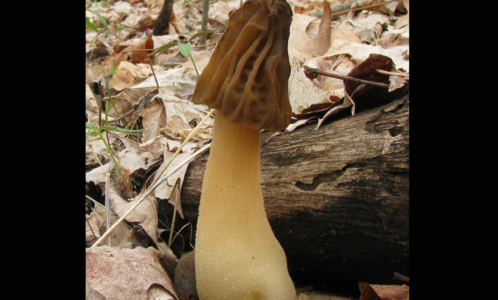
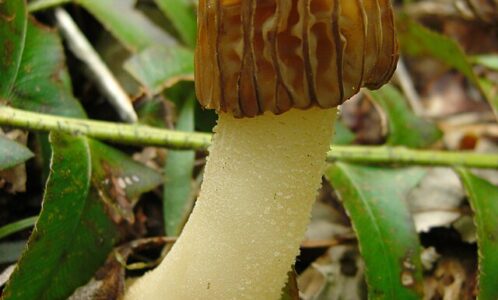
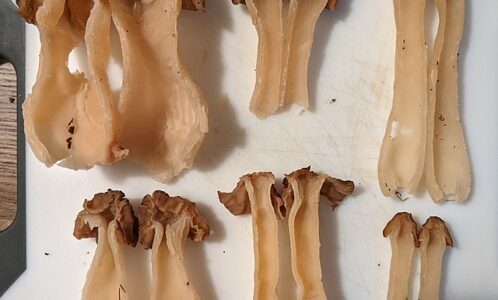
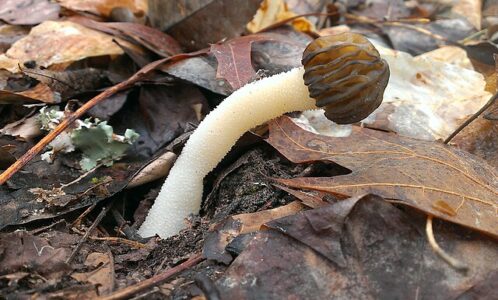
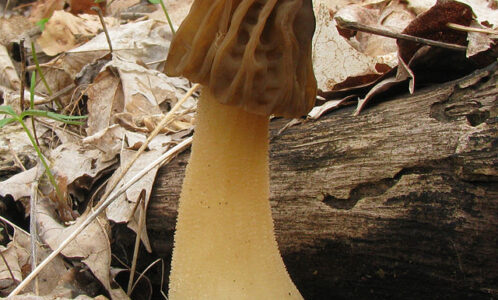
IDENTIFICATION: THE HALF-ATTACHED CAP
THE CAP:
- Honeycomb texture on the TOP half – pits and ridges like a true morel
- Bottom half hangs FREE from the stem – this is the defining feature
- Looks like a morel wearing a skirt that’s too big
- Conical shape
- Tan to brown, sometimes grayish
- Smaller than typical true morels (usually 1-3 inches tall)
- The pitted portion is relatively short compared to the stem
THE STEM:
- Proportionally LONG compared to the cap
- White to cream colored
- Often has cottony or fibrous material inside (not completely hollow like true morels)
- Smooth or slightly granular texture
- Can be quite tall relative to the small cap
THE INTERIOR:
- Cap portion is hollow
- Stem often has cottony filling or loose fibers
- Not one completely smooth hollow chamber like true morels
- This cottony stem is a key identification point
THE SMELL:
- Earthy, mushroomy
- Pleasant
- Similar to other morels
THE SPORE PRINT:
- Cream to pale yellow
WHERE HALF-FREE MORELS GROW
HABITAT:
Half-Free Morels grow in similar locations to true morels:
- Hardwood forests
- Areas with ash, elm, apple, tulip poplar
- Disturbed soil
- Wood chips and mulch
- Stream banks and floodplains
- Sometimes in the same locations as true morels
SEASON:
- Early spring – often BEFORE true morels
- This early timing is important for identification
- Can overlap with true morel season
- March-April in most regions (earlier in South, later in North)
DISTRIBUTION:
Throughout North America, Europe, and temperate regions worldwide.
THE CONFUSION WITH FALSE MORELS
Here’s where Half-Free Morels cause problems for beginners:
The Similarities to Gyromitra (False Morels):
- Cap hangs free at bottom – both have this feature
- Cottony stem interior – both often have this
- Can appear at similar times – spring overlap
- Growing in similar habitat – both like disturbed areas
How to Tell Them Apart:
| Feature | HALF-FREE MORELS | FALSE MORELS (Gyromitra) |
|---|---|---|
| Cap texture | Honeycomb pits on top half | Brain-like wrinkles all over |
| Cap shape | Conical, organized | Irregular, lobed, wavy |
| Cap attachment | Free on bottom HALF | Free all around, wavy edge |
| Cap interior | Hollow | Chambered, irregular |
| Stem | Long, cottony inside | Thick, cottony/solid |
The Critical Difference:
Half-Free Morels have that honeycomb texture on the attached portion. False Morels have brain-like wrinkles. If you see clear pits and ridges (even if only on the top half), it’s a Half-Free Morel, not a False Morel.
When Young:
Young Half-Free Morels can look suspiciously like young False Morels before the honeycomb pattern is fully developed. This is when mistakes happen. If in doubt, let it mature another day or two, or skip it entirely.
ARE HALF-FREE MORELS EDIBLE?
Short answer: Yes, but…
The “But”:
- Less desirable flavor – not as rich or meaty as true morels
- Tougher texture – more fibrous, less tender
- Cottony stem – the stem isn’t as good to eat (many people discard it)
- Easy to confuse with toxic species when young
- Some people report digestive upset (though this is debated)
What Foragers Do:
- Dedicated morel hunters: Often skip them entirely, looking for “real” morels
- Beginning foragers: Sometimes avoid them due to confusion with False Morels
- Practical foragers: Will harvest them if true morels are scarce
- Early season foragers: May collect them as the “first morels” while waiting for better species
PREPARATION AND COOKING
If you decide to harvest Half-Free Morels:
Cleaning:
- Cut in half lengthwise (check for bugs, verify honeycomb pattern)
- Soak in salted water (removes debris and bugs)
- Pat dry
Cooking:
- MUST be cooked thoroughly (like all morels – never eat raw)
- Cook at least 15-20 minutes
- Many people discard the stem (or use it for stock)
- The cap portion cooks more evenly if separated from stem
Best Uses:
- Sautéed in butter (classic method)
- Added to cream sauces
- Mixed with other mushrooms
- Used in soups or stocks
- Dried and rehydrated (helps tenderize them)
Flavor:
Milder than true morels. Somewhat earthy and mushroomy, but lacks the deep, nutty complexity of Morchella esculenta or M. elata.
Texture:
Tougher and more fibrous than true morels, especially the stem. The cap is better.
WHY MOREL HUNTERS SKIP THEM
Honest reasons foragers avoid Half-Free Morels:
- They’re just not as good – if you’re going to spend time in the woods looking for morels, why settle for the mediocre ones?
- Confusion risk – especially for beginners, the similarity to young False Morels isn’t worth the risk
- Time investment – time spent harvesting Half-Frees is time not spent looking for better morels
- They appear early – if you’re finding Half-Frees, it means the GOOD morels aren’t up yet, so keep looking
- Cultural perception – in morel hunting culture, Half-Frees just don’t have the prestige
The Honest Truth:
They’re edible, they’re not toxic, and if you’re hungry and they’re there, they’ll make a meal. But nobody’s calling in sick to work to hunt Half-Free Morels.
THE EARLY INDICATOR
Half-Free Morels have one valuable role: they’re a sign that true morel season is approaching.
If you find Half-Free Morels, it means:
- Soil temperature is right
- Conditions are favorable
- True morels will likely appear in 1-2 weeks
So they’re actually useful as a “scout” species – they tell you it’s time to start checking your morel spots regularly.
COMPARISON WITH VERPA (Peckerheads)
Half-Free Morels are sometimes confused with Verpa species (Thimble Morels), but they’re different:
| Feature | HALF-FREE MORELS | VERPA |
|---|---|---|
| Cap texture | Honeycomb pits | Wrinkled, NOT honeycomb |
| Cap attachment | Attached halfway | Attached only at very top |
| Stem length | Long | VERY long (disproportionate) |
| Edibility | Edible (mediocre) | Edible but can cause upset |
Both are “meh” compared to true morels, but they’re different species.
THE TAXONOMIC DEBATE
Mycologists have debated whether Half-Free Morels are:
- A distinct species (M. punctipes)
- A variant of another morel species
- Multiple species lumped together
Recent DNA analysis suggests they’re distinct. But taxonomy is always evolving.
For foragers, it doesn’t matter much – they’re recognizable by that half-attached cap regardless of what scientists call them.
SAFETY CONSIDERATIONS
Positive ID Required:
- NEVER assume “close enough” with mushrooms
- Always verify the honeycomb texture on the cap
- Cut in half to check interior structure
- When in doubt, leave it out
Cook Thoroughly:
- Even true morels can cause upset if undercooked
- Half-Free Morels should be cooked at least 15-20 minutes
- Never eat raw
Start Small:
- If trying Half-Free Morels for the first time, eat a small amount
- Some people report digestive issues (though this may be due to undercooking)
- Wait a day to see how you react before eating more
Know Your Look-Alikes:
- Study False Morels thoroughly
- Learn the differences between honeycomb and brain-like texture
- Don’t harvest young specimens if you’re not confident
FINAL THOUGHTS
Half-Free Morels are the mushroom equivalent of “technically correct.” Yes, they’re morels. Yes, they’re edible. Yes, you CAN eat them.
But should you? That depends.
Reasons to harvest them:
- You’re early in the season and excited about any morels
- True morels are scarce in your area
- You want practice identifying morel features
- You’re not picky and free food is free food
Reasons to skip them:
- Better morels are available
- You’re not confident distinguishing them from False Morels
- You have limited foraging time and want to focus on premium species
- You’ve tried them before and weren’t impressed
My take:
Half-Free Morels are perfectly fine, safe, edible mushrooms. They’re also not particularly exciting. If you’re a beginning forager, focus on learning true morels and False Morels first – get those identifications solid. Half-Frees can wait.
If you’re an experienced forager and you find Half-Frees early in the season, sure, harvest a few if you want. Just manage your expectations. They’re not going to blow your mind.
They’re the mushroom you settle for while dreaming of better ones.
For true morel identification, see Morels. For toxic look-alikes, see False Morels and Deadly Doubles: The Honeycomb Trap. For other edible mushrooms, see the Flora Archive.