
The Beautiful Destroyer
⚠️ ECOLOGICAL THREAT – Not toxic to humans, but catastrophic to wetland ecosystems
Purple Loosestrife is gorgeous. Tall spikes of magenta flowers lining wetlands and ditches, blooming prolifically all summer long. It looks like it belongs there. It looks natural.
It’s not. It’s an invasive species that destroys native wetland plant communities, eliminates wildlife habitat, and turns diverse ecosystems into monoculture wastelands. And once it establishes, it’s nearly impossible to eradicate.
This is why it’s in the Poison Index despite not being toxic to humans – because it poisons ecosystems. And because people keep confusing it with medicinal plants and accidentally spreading it.
WHAT IS PURPLE LOOSESTRIFE?
Botanical Name: Lythrum salicaria
Also Known As: Purple Lythrum, Spiked Loosestrife
Family: Lythraceae
Legal Status: Listed as a noxious weed in most U.S. states and Canadian provinces. In many places, it’s illegal to plant, propagate, or transport Purple Loosestrife.
Native Range: Europe, Asia
Invasive Range: North America (all lower 48 states, most of Canada)
What It Looks Like:
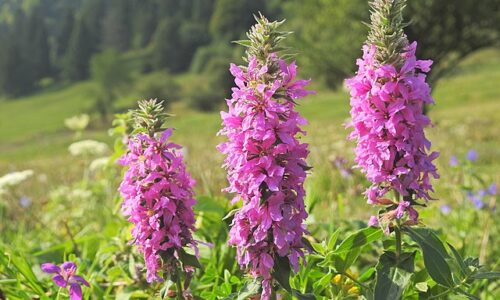
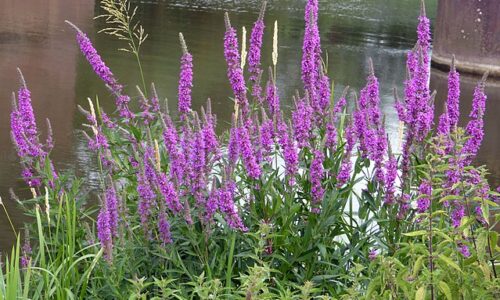
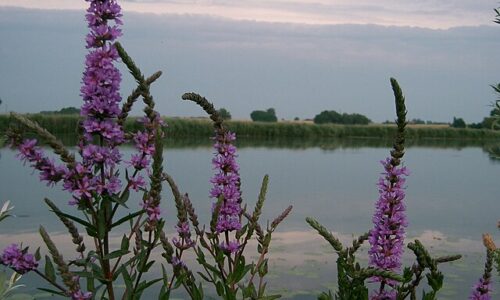
- Tall spikes of magenta to purple flowers
- 3-7 feet tall (often much taller than native plants)
- Flowers have 5-7 petals (usually 6) that look wrinkled or crinkled
- Blooms June through September (long bloom time)
- Forms dense stands
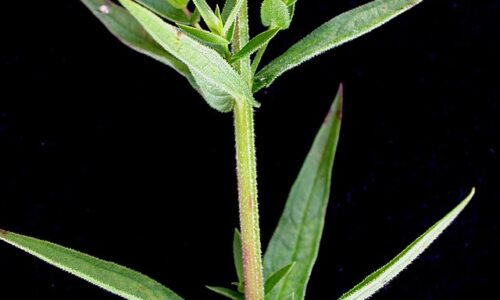
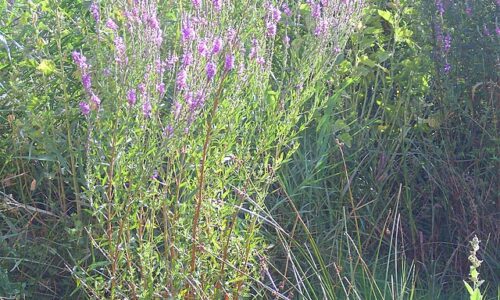
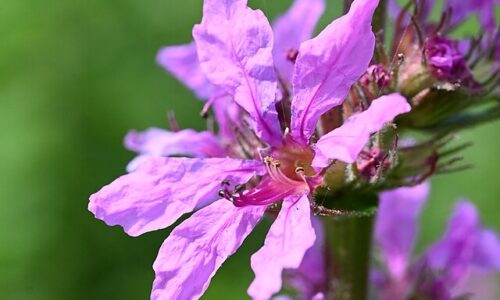
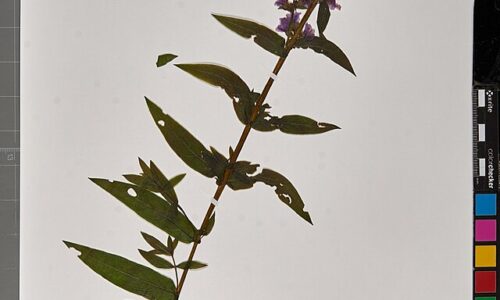
IDENTIFICATION
THE FLOWERS:
- Long, showy spikes of magenta-purple flowers
- Each individual flower has 5-7 petals (typically 6)
- Petals have a wrinkled, crinkled texture like tissue paper
- Flowers arranged densely up the spike
- Spikes can be 1-2 feet long
THE STEM:
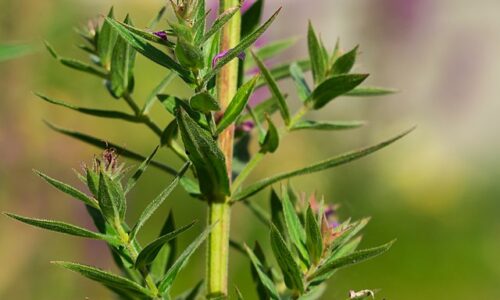
- Square to hexagonal in cross-section (4-6 sided)
- Stiff, upright
- Becomes woody at the base as plant matures
- Often reddish
THE LEAVES:
- Lance-shaped (pointed, narrow)
- SESSILE – attach directly to stem with NO leaf stalk (this is a key ID feature)
- Arranged in opposite pairs or whorls of 3
- Downy or slightly hairy
- 1-4 inches long
THE HEIGHT:
- Typically 3-7 feet tall
- Can reach 10 feet in ideal conditions
- Towers over most native wetland plants
THE HABITAT:
- Wetlands, marshes, ditches
- Stream and pond edges
- Anywhere with consistent moisture
- Can tolerate some flooding
THE SEEDS:
- ONE plant can produce 2-3 MILLION seeds per year
- Seeds remain viable in soil for years
- Spread by water, wildlife, contaminated equipment, boots
WHAT MAKES IT DANGEROUS (To Ecosystems)
Purple Loosestrife isn’t toxic to humans or livestock. The danger is ecological:
How it destroys wetlands:
- Outcompetes native plants – grows faster, taller, denser than natives
- Forms monocultures – entire wetlands become nothing but Purple Loosestrife
- Provides little food value – native wildlife can’t eat it (no co-evolution)
- Destroys habitat – waterfowl, amphibians, fish lose critical breeding/feeding areas
- Alters hydrology – changes water flow and sediment patterns
- Nearly impossible to eradicate once established
The economic impact:
- Millions of dollars spent annually on control efforts
- Loss of wetland ecosystem services
- Decreased property values near infested wetlands
- Agricultural irrigation system clogging
Why it spreads so effectively:
- Massive seed production (millions per plant)
- Seeds spread by water, birds, mammals, humans
- Can also spread by root fragments
- Tolerates a wide range of conditions
- No natural predators in North America
THE CONFUSING LOOK-ALIKES
People confuse Purple Loosestrife with beneficial plants, which is how it keeps spreading:
SPANISH LAVENDER (Lavandula stoechas) – BENEFICIAL
| Feature | PURPLE LOOSESTRIFE | SPANISH LAVENDER |
|---|---|---|
| Scent | NO scent or faint green smell | STRONG camphor/pine scent |
| Flowers | Magenta spikes, wrinkled petals | Purple with “bunny ear” bracts on top |
| Height | 3-7 feet tall | 1-3 feet, compact shrub |
| Habitat | Wetlands | Dry, well-drained gardens |
| Stem | Square/hex, woody base | Square, woody throughout |
| Leaves | Sessile (no leaf stalk) | With tiny stalks, gray-green |
Key difference: Spanish Lavender smells STRONGLY of camphor. Purple Loosestrife has no distinctive scent.
BLUE VERVAIN (Verbena hastata) – NATIVE & BENEFICIAL
| Feature | PURPLE LOOSESTRIFE | BLUE VERVAIN |
|---|---|---|
| Flowers | Magenta, wrinkled, 5-7 petals | Blue-violet, small, tubular |
| Flower spike | Dense, thick | Thin, candelabra-like multiple spikes |
| Height | 3-7 feet | 2-5 feet |
| Leaves | Lance, sessile | Toothed, with leaf stalks |
| Habitat | Wetlands (invasive) | Wetlands (native) |
Key difference: Blue Vervain has multiple thin flower spikes branching like a candelabra, not single thick spikes.
FIREWEED (Chamerion angustifolium) – NATIVE
| Feature | PURPLE LOOSESTRIFE | FIREWEED |
|---|---|---|
| Flowers | Magenta, 5-7 wrinkled petals | Pink-magenta, 4 smooth petals |
| Height | 3-7 feet | 3-6 feet |
| Habitat | Wetlands | Disturbed areas, burns |
| Leaves | Sessile | With leaf stalks, willow-like |
See: Deadly Doubles: The Purple Spike Trap for detailed comparison
TRADITIONAL MEDICINAL USE (Historical Context)
I’m providing this for historical completeness, NOT as a recommendation to use this invasive plant.
Purple Loosestrife has a long history in European herbal medicine:
Historical uses:
- Astringent/styptic – high tannin content, used to stop bleeding
- Diarrhea and dysentery – tannins “bind” the digestive tract
- Wound wash – topical application for cuts and ulcers
- Skin conditions – used for eczema, inflammation
Active constituents:
- High tannin content (10-14%)
- Anthocyanins
- Flavonoids
Traditional preparations:
Decoction (wound wash):
- 1 oz dried herb to 1 pint water
- Boil and reduce by 1/3
- Apply topically to wounds
Tincture:
- Dried flowering tops in 40-50% alcohol
- 1:5 ratio
- Used for acute diarrhea
Why you shouldn’t use it:
- It’s invasive – harvesting can spread seeds
- Better alternatives exist – yarrow, plantain, oak bark all have similar properties without ecological damage
- High tannin = constipation – excessive use causes severe constipation
- Legal issues – transporting or using may violate noxious weed laws
The ethical problem: Even if you’re harvesting it to “control” it, handling the flowers risks spreading seeds. Use native alternatives instead.
WHAT TO DO IF YOU FIND IT
If you encounter Purple Loosestrife:
DO:
- Report it to your local extension office or invasive species coordinator
- Photograph it for identification confirmation
- Note the location (GPS coordinates if possible)
- Learn to identify it so you can spot new infestations
DON’T:
- Don’t touch flowering plants (seeds stick to clothing, spread easily)
- Don’t pull and discard (fragments can reroot, seeds spread)
- Don’t mow (spreads seeds, stimulates regrowth)
- Don’t compost (seeds survive)
- Don’t plant (obviously – but people still do)
SMALL INFESTATIONS (a few plants, caught early):
- Hand-pull wearing gloves
- Get entire root system
- Before seed set (critical timing)
- Bag all plant material
- Dispose in trash (not yard waste, not compost)
- Monitor site for regrowth
LARGE INFESTATIONS:
- Contact local invasive species management
- May require herbicide treatment
- Biological control (beetles) in some regions
- Professional management needed
NEVER BURN – seeds can survive fire
THE SEED PROBLEM
One plant producing 2-3 million seeds means:
How seeds spread:
- Stick to boots, clothing, equipment
- Float on water (can travel miles downstream)
- Eaten by birds (pass through digestive system viable)
- Contaminated soil or mulch
- Attached to vehicles, boats, trailers
How to prevent spread:
- Clean boots after hiking in wetlands
- Wash vehicles after visiting infested areas
- Don’t move soil or plants from infested sites
- Never plant Purple Loosestrife (even “sterile” varieties can cross-pollinate)
Why “sterile” varieties aren’t safe:
Garden centers once sold “sterile” cultivars, claiming they wouldn’t spread. This was wrong:
- They cross-pollinate with wild types
- Resulting offspring are fertile
- Contributed to spread
- Now banned in most places
LEGAL STATUS
Purple Loosestrife is:
Federal:
- Listed as noxious weed
State/Provincial:
- Banned in most U.S. states – illegal to plant, propagate, or transport
- Listed as noxious weed in almost all states where it occurs
- Prohibited species in many Canadian provinces
Check your local regulations – possessing or transporting Purple Loosestrife may be illegal where you live.
WHY IT MATTERS
“It’s just a pretty flower” – this is what people said in the 1800s when they brought Purple Loosestrife to North America as an ornamental.
Now:
- Millions of acres of wetlands degraded
- Native plant species displaced
- Wildlife habitat destroyed
- Waterfowl populations impacted
- Fish spawning areas lost
- Millions of dollars spent on control
The lesson: Invasive species have long-term, widespread consequences. Individual choices (planting, spreading, ignoring) add up to ecosystem collapse.
THE IRONY
Purple Loosestrife is beautiful. That’s the problem. It’s showy, easy to grow, blooms all summer. It LOOKS like it should be there.
But beauty doesn’t equal belonging. And in ecology, belonging matters.
Other plants with similar flowers that ARE appropriate:
- Native blazing stars (Liatris species)
- Native ironweeds (Vernonia species)
- Native purple coneflower (Echinacea)
- Cultivated perennials (phlox, salvia, veronica)
All provide similar beauty without destroying ecosystems.
FINAL THOUGHTS
Purple Loosestrife isn’t toxic to humans in the traditional sense. You won’t die from touching it or eating it (though I wouldn’t recommend it).
But it’s toxic to ecosystems. It poisons wetlands by eliminating diversity, destroying habitat, and creating biological deserts where only one species thrives.
Learn to identify it. Report it. Support eradication efforts. Don’t spread it. And for the love of functional ecosystems, don’t plant it because it’s “pretty.”
If you see purple spikes in wetlands:
- Check for sessile leaves (no leaf stalks)
- Count petals (5-7, wrinkled)
- Check height (often 3-7 feet)
- Smell it (no strong scent = probably Loosestrife)
- Report it
We can’t undo the damage already done, but we can prevent it from getting worse.
Every wetland still free of Purple Loosestrife is worth protecting. Every new infestation caught early is one that won’t spread. Every person who learns to identify it is one less vector for seeds.
That’s worth more than any historical medicinal use.
For beneficial look-alikes, see Spanish Lavender and other plants in the Flora Archive. For identification comparison, see Deadly Doubles: The Purple Spike Trap.