
The Peckerheads Nobody Wants
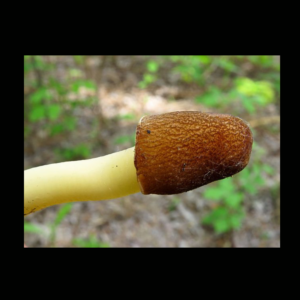
Let me be direct: Verpa are the mushrooms that disappoint morel hunters. You’re scanning the forest floor in early spring, heart racing at the sight of what looks like a morel from a distance. You get closer. “Oh. It’s a Verpa.” And you keep walking.
They’re technically edible. They’re also confusing, potentially problematic, and honestly not worth the effort when better mushrooms exist. But you should learn to identify them – partly so you don’t waste time on them, and partly so you don’t confuse them with actual morels or (worse) with False Morels.
WHAT ARE VERPA?
Verpa are mushrooms in their own genus (Verpa), separate from true morels (Morchella) despite superficial similarities. The two main species foragers encounter:
Verpa bohemica:
- More common
- Yellowish-brown to tan cap
- Called “Early Morel,” “Thimble Morel,” or “Wrinkled Thimble Cap”
Verpa conica:
- Less common
- Darker, more conical cap
- Smoother surface than V. bohemica
Both share the same basic characteristics and the same “peckerhead” nickname.
Common Names:
- Peckerheads (the most common and memorable name – refers to the shape)
- Thimble Morels
- Early Morels
- False Morels (confusing, since Gyromitra are also called this)
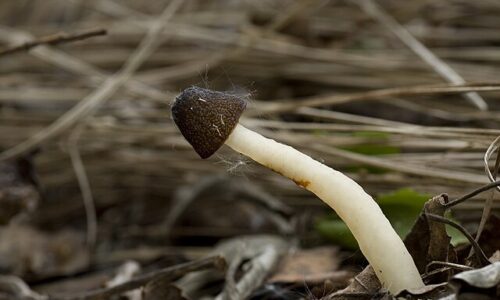
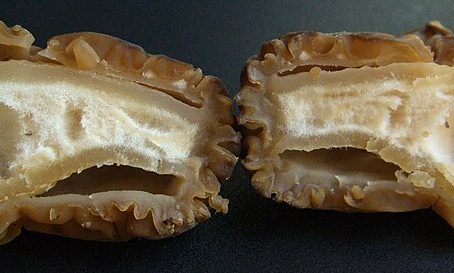
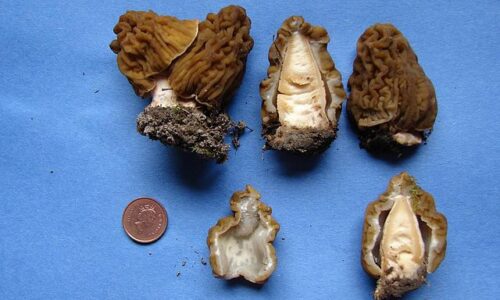
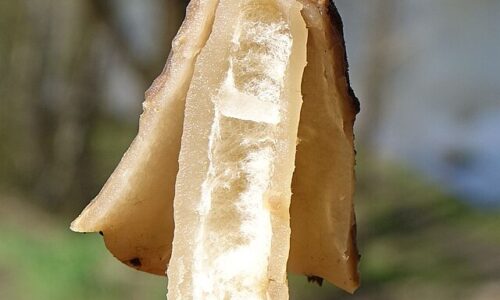
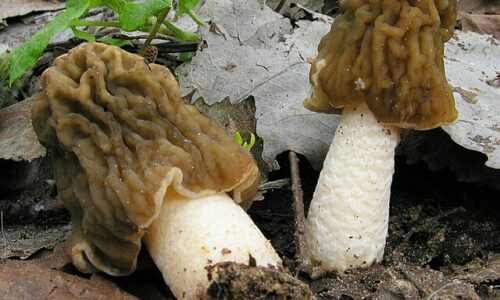
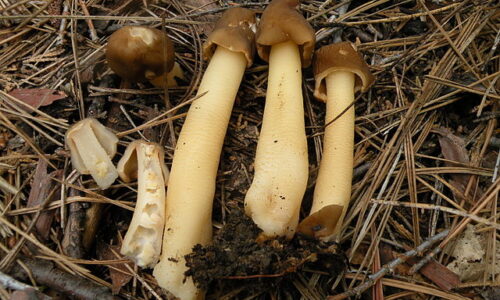
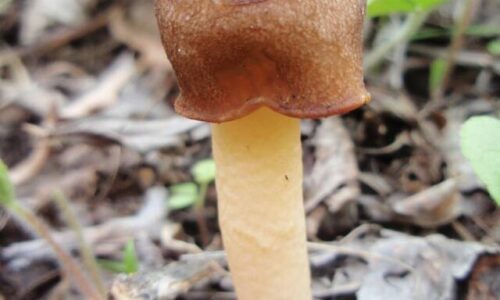
IDENTIFICATION: THE DISPROPORTIONATE ANATOMY
THE CAP:
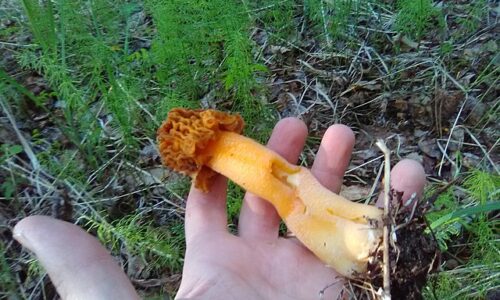
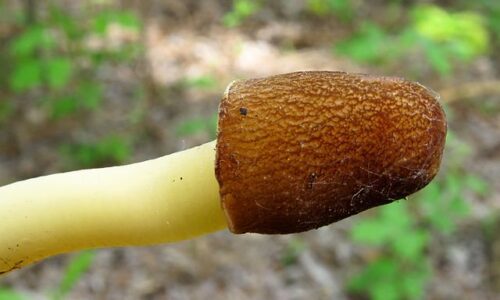
- Thimble or bell-shaped – hangs down like a bell or thimble
- Wrinkled surface but NOT honeycomb – this is critical
- NO organized pits and ridges like true morels
- Surface has wrinkles, folds, or is relatively smooth (depending on species)
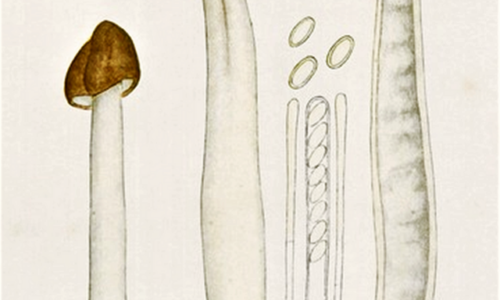
- Attached ONLY at the very top – hangs completely free from the stem like a skirt
- Yellowish-brown, tan, or darker brown
- Small relative to stem length (1-2 inches tall)
THE STEM:
- Disproportionately LONG – this is the defining feature
- Stem is often 2-4 times longer than the cap
- White to cream colored
- Relatively thick
- Filled with cottony or fibrous material (NOT hollow like true morels)
- Smooth or slightly granular
- Brittle, breaks easily
THE INTERIOR:
- Cap is hollow
- Stem is stuffed with cottony material – white, fluffy fibers inside
- NOT one smooth hollow chamber like true morels
THE SHAPE:
The overall shape is… well, phallic. Hence “peckerhead.” A long white stem with a small cap on top. Once you see one, the name makes perfect sense and you’ll never forget it.
THE SMELL:
- Mild, slightly earthy
- Not particularly distinctive
THE SPORE PRINT:
- Cream to pale yellow
WHERE VERPA GROW
HABITAT:
- Hardwood and mixed forests
- Areas with cottonwood, aspen, willow (particularly near streams)
- Floodplains and bottomlands
- Disturbed soil
- Wood chips, mulch
- Often in wetter areas than true morels
SEASON:
- Early spring – often BEFORE true morels
- This early timing causes confusion (people see “morel-like” mushrooms and get excited)
- March-April in most regions
- Can overlap with early true morel season
DISTRIBUTION:
Throughout North America, particularly common in the Midwest and along waterways.
THE CONFUSION FACTOR
Verpa confuse beginners for several reasons:
Why People Think They’re Morels:
- Spring timing (when people are morel hunting)
- Brownish cap (morel-colored)
- Roughly the right size
- Grow in woodlands
- Called “Early Morels” (misleading common name)
How They’re Different from True Morels:
| Feature | TRUE MORELS | VERPA |
|---|---|---|
| Cap texture | Distinct honeycomb | Wrinkled, NOT honeycomb |
| Cap attachment | Attached all around bottom | Attached ONLY at top |
| Stem proportion | Proportional to cap | MUCH longer than cap |
| Interior | Completely hollow | Stem cottony-stuffed |
| Shape | Conical or rounded | Thimble on a long stick |
The Dead Giveaway:
That disproportionately long stem with the cottony interior. If you cut a Verpa in half and see white fluffy material filling the stem, it’s not a morel.
THE CONFUSION WITH FALSE MORELS
Verpa also get confused with False Morels (Gyromitra), which is more dangerous:
Similarities:
- Cap hangs free from stem
- Cottony stem interior
- Spring season
- Similar habitats
Differences:
| Feature | VERPA | FALSE MORELS (Gyromitra) |
|---|---|---|
| Cap texture | Wrinkled or smooth | Brain-like, convoluted |
| Cap shape | Bell/thimble, regular | Irregular, lobed, saddle |
| Stem length | Very long | Proportional, thick |
| Overall shape | Slim, tall | Chunky, irregular |
If you can’t tell the difference, don’t eat either of them.
ARE VERPA EDIBLE?
Technically: Yes, Verpa are considered edible with proper preparation.
Realistically: It’s complicated.
The Problems:
- Contains small amounts of hydrazines – same chemical family as the toxins in False Morels (gyromitrin), but in much lower concentrations
- Can cause gastric upset in some people – nausea, vomiting, diarrhea
- Individual sensitivity varies – some people eat them with no issues, others get sick
- Cumulative toxicity is possible – repeated consumption may build up toxins
- Cooking is essential – NEVER eat raw (like all wild mushrooms)
- Quality is poor – even when properly prepared, they’re not particularly good
What Various Sources Say:
- Some field guides: List as edible with caution
- Other field guides: Recommend avoiding them
- Foragers: Opinions range from “they’re fine” to “not worth the risk”
- Mycologists: Generally advise caution due to hydrazine content
The Conservative Approach:
Given that they contain toxins (even if in small amounts), some people react badly, and they’re not even delicious, why bother? There are plenty of truly safe, truly tasty mushrooms to forage.
PREPARATION (If You Insist)
If you decide to try Verpa despite all the warnings:
Critical Safety Steps:
- Positive identification – be 100% certain it’s Verpa and not False Morels
- Cook thoroughly – at least 20-30 minutes of cooking
- Never eat raw
- Start with small amounts – test your individual tolerance
- Don’t eat repeatedly – avoid cumulative toxicity
- Some sources recommend parboiling (boiling briefly, discarding water) before cooking
Preparation:
- Cut in half lengthwise
- Remove the cottony stem (many people discard it entirely)
- Soak in salted water
- Cook cap portion thoroughly
Flavor:
Mild, somewhat earthy. Not impressive. Definitely not worth the effort compared to true morels or other choice edibles.
Texture:
Somewhat tough and fibrous, especially the stem.
WHY FORAGERS SKIP THEM
Honest reasons experienced foragers avoid Verpa:
- The risk-reward doesn’t add up – why eat something that contains known toxins (even low levels) when safer options exist?
- They’re not good – even properly cooked, they’re mediocre at best
- Individual reactions vary – you might be one of the people who gets sick
- Confusion risk – too easy to mistake for False Morels if you’re not careful
- They appear early – if you’re finding Verpa, better morels are probably coming soon anyway
- Cumulative toxicity concerns – eating them regularly seems like a bad idea
The Foraging Logic:
“If I spend time harvesting, cleaning, and cooking mushrooms, they should either be delicious OR completely safe. Verpa are neither.”
THE EARLY INDICATOR ROLE
Like Half-Free Morels, Verpa have one useful function: they tell you morel season is approaching.
If you find Verpa, it means:
- Soil temperature is warming
- Spring conditions are right
- True morels should appear within 1-2 weeks
- Time to start checking your morel spots
So they’re useful scouts, even if you don’t harvest them.
THE PECKERHEAD NAME
Let’s address this directly: the common name “peckerhead” is vulgar but accurate. The mushroom looks like a penis. A long white shaft with a small brown head.
This is actually a GOOD thing for identification – once you learn this name and see the shape, you’ll never confuse Verpa with anything else. The name is memorable, descriptive, and instantly recognizable.
Is it crude? Yes. Is it effective for teaching mushroom ID? Absolutely.
Other names exist (Early Morel, Thimble Cap), but “peckerhead” is what most foragers actually call them, and it’s the name that sticks in your memory.
COMPARISON SUMMARY
Verpa vs. True Morels:
- Verpa: Wrinkled cap, free-hanging, cottony stem, very long
- True Morels: Honeycomb cap, attached cap, hollow stem, proportional
Verpa vs. False Morels:
- Verpa: Slim, regular thimble shape, very long stem
- False Morels: Chunky, brain-like texture, irregular shape
Verpa vs. Half-Free Morels:
- Verpa: Cap attached ONLY at tip-top, wrinkled texture, VERY long stem
- Half-Free: Cap attached halfway, honeycomb texture, moderately long stem
If in doubt: Cut it in half. Completely hollow throughout = true morel. Cottony stem filling = not a true morel (could be Verpa, Half-Free, or False Morel – needs more investigation).
THE REALITY CHECK
Here’s the bottom line on Verpa:
What they are:
- A distinct mushroom genus
- Technically edible (with caveats)
- Early spring mushrooms
- Easy to identify once you know what to look for
What they’re not:
- True morels
- Worth the effort
- Particularly safe (contain low levels of toxins)
- Delicious
What foragers do:
- Learn to identify them (so they don’t waste time)
- Use them as indicators that morel season is near
- Walk right past them looking for better mushrooms
- Maybe photograph them (they are distinctive-looking)
- Don’t harvest them
FINAL THOUGHTS
Verpa occupy an odd space in mushroom foraging: they’re not toxic enough to be in the “poison index,” but they’re not good enough or safe enough to recommend eating. They’re the mushrooms that disappoint.
If you find Verpa, congratulations – you’ve learned to identify another spring mushroom. Now leave them alone and keep looking for actual morels.
My advice:
- Learn to identify Verpa so you can recognize them instantly
- Don’t waste your time harvesting them
- Use them as a sign that better mushrooms are coming
- If someone offers you “morels” that turn out to be Verpa, politely decline
- Save your basket space for actual morels
There are so many genuinely safe, genuinely delicious wild mushrooms to forage. Verpa aren’t on that list.
Learn them. Recognize them. Walk past them. That’s the Verpa foraging strategy in a nutshell.
And yes, they really do look like peckers.
For true morel identification, see Morels. For toxic look-alikes, see False Morels. For comparison, see Deadly Doubles: The Honeycomb Trap. For other edible mushrooms, see the Flora Archive.