
The One You Already Know (But Probably Don’t Know Well Enough)
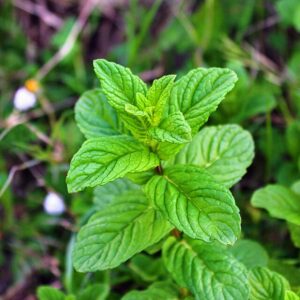
Everyone thinks they know peppermint. It’s in the tea aisle, the toothpaste, the candy cane, the cocktail garnish. It is one of the most recognized plant scents on earth, which is precisely why people get careless with it. Familiarity breeds a kind of lazy confidence, and lazy confidence is how you end up with a mouthful of pennyroyal thinking you grabbed something harmless.
Peppermint is not dangerous in the way hemlock is dangerous. But it belongs to a family where knowing the difference between your plant and its cousins matters, and one of those cousins can damage your liver and has killed people who confused it for something benign. So before we talk about what peppermint does, let’s make sure you actually have peppermint.
FIELD IDENTIFICATION: THE THREE-POINT CHECK
1. The Stem (Touch/Visual) Pick up a stem and roll it between your fingers. Every true member of the Lamiaceae (mint) family has a distinctively square stem, four-sided, with visible ridges at the corners. Round stem means it is not a mint. This alone narrows the field considerably. Peppermint stems range from green to reddish-purple, often with fine hairs, and are moderately sturdy, not wiry.
2. The Scent (Smell) Crush a leaf firmly between your fingers and smell it immediately. True peppermint (Mentha x piperita) produces a sharp, clean, high menthol scent, instantly recognizable as the thing in your toothpaste. It is cooling and bright and unmistakably peppermint, not spearmint (sweeter, gentler), not pennyroyal (mintier but with a harsh, acrid undertone and a camphor quality that will make you pull your hand back), not lemon balm (lemony, no menthol). If you cannot clearly identify the scent as classic peppermint, do not proceed to use it as peppermint.
3. The Leaf (Visual) Peppermint leaves are oval to lance-shaped with sharply serrated edges, growing in opposite pairs on the stem. They are dark green on top, paler underneath, and typically 4 to 9 centimeters long on mature plants. The leaf surface has a slightly textured, slightly wrinkled appearance. Leaves attach directly to the stem with very short petioles (leaf stalks) or sometimes nearly stalkless. The combination of serrated leaf edges, opposite arrangement, square stem, and that unmistakable menthol scent together constitute a solid identification.
PRIMARY MARKERS
- Leaves: Oval, dark green, sharply toothed margins, opposite pairs on the stem. Short or nearly absent leaf stalks.
- Flowers: Small, pale purple to lilac, in dense whorled clusters forming a terminal spike. Blooms mid to late summer. Four petals, mildly fragrant.
- Stem: Square, reddish-purple to green, upright to slightly sprawling, 30 to 90 cm tall.
- Roots: Spreads aggressively by underground rhizome. If you plant it in a garden without containment, it will take over. This is not a threat. It is a promise.
- Habitat: Moist, disturbed ground. Streambanks, ditches, field edges, and surprisingly often: old homestead sites. Peppermint, spearmint, and lemon balm growing seemingly wild in the middle of nowhere frequently mark the ghost of a garden that was tended by someone who knew what they were doing.
THE HISTORICAL RECORD
Dried peppermint leaves have been found in Egyptian tombs dating back more than 3,000 years, indicating use for both medicinal and ceremonial purposes. While most mints have been known since ancient times, it was not until 1696 that peppermint was formally described by English botanist John Ray in his Synopsis Methodica Stirpium Britannicarum. The plant was added to the London Pharmacopoeia in 1721.
In traditional Chinese medicine, mint is believed to have pungent and cool properties, used to expel wind and heat, clear the head and eyes, and remove liver qi stagnation. In Ayurvedic medicine it was used to help digestive conditions, skin problems, and headaches. In ancient Greece it was added to baths, used to treat mouth sores, and to whiten teeth.
In ancient Greece, mint was considered a symbol of hospitality: it was customary to perfume houses with it when guests arrived, and banquets often ended with an aromatic preparation made from this plant.
The medicinal use of mint for digestive disorders dates back to ancient Greece, Rome, and Egypt, and peppermint has been used for centuries to treat gastrointestinal ailments. Today it is one of the most widely cultivated and researched herbs in the world, and one of the few where the traditional use and modern clinical evidence actually line up with reasonable consistency.
WHAT PEPPERMINT IS TRADITIONALLY CLAIMED TO DO
Peppermint has been used or claimed across traditional and alternative health contexts for a wide range of applications. These include digestive support including bloating, gas, indigestion, nausea, and irritable bowel syndrome; headache and migraine relief applied topically to the temples; respiratory support and decongestant action via steam inhalation; muscle pain relief via topical application; fever reduction through diaphoretic action; oral health including breath freshening, antimicrobial action against oral bacteria, and gum health; mental alertness and focus via aromatherapy; sinus congestion; itching and skin irritation relief topically; nausea during pregnancy and chemotherapy; antispasmodic effects on the gut and bile ducts; and general immune and antioxidant support. As with all of the above, these are traditional and alternative claims. Nothing here constitutes medical advice, and nothing should be taken as a recommendation to use peppermint for any health condition.
TRADITIONAL AND CONTEMPORARY APPLICATIONS
Nothing in this section constitutes medical advice or a health claim. This is a record of historical and traditional use, shared for educational purposes only.
The Digestive Application
This is peppermint’s home territory and where the evidence is strongest. Menthol, the primary active constituent making up roughly 40% of peppermint essential oil, relaxes smooth muscle in the gastrointestinal tract. This is why peppermint tea after a heavy meal is not just tradition — it has a mechanistic rationale. The relaxation of intestinal smooth muscle reduces cramping and spasm, eases the passage of gas, and supports the flow of bile from the gallbladder. Peppermint oil capsules are licensed as a medicine in the UK for the treatment of irritable bowel syndrome.
The important caveat: that same smooth muscle relaxation affects the lower esophageal sphincter, the valve between the stomach and esophagus. For people with GERD or acid reflux, peppermint can worsen symptoms by allowing stomach acid to travel upward more easily. If you have reflux, peppermint tea is not your friend, regardless of how soothing it sounds.
The Headache Application
Peppermint oil is defined as an essential oil used for topical application to relieve headache and nausea, demonstrating effectiveness comparable to acetaminophen in pain reduction. Diluted peppermint essential oil applied to the temples and forehead at the onset of a tension headache is one of the better-supported topical herbal applications in the literature. The menthol activates cold-sensitive receptors in the skin, creating a cooling sensation that modulates pain perception, and the mild vasoactive effects may help with the vascular component of headache.
Respiratory and Inhalation Use
Steam inhalation of peppermint tea or a few drops of peppermint essential oil in hot water is a traditional decongestant remedy that makes physiological sense. Menthol activates cold receptors in the nasal passages and upper airways, creating a sensation of increased airflow even when the anatomy hasn’t changed. It also has mild expectorant properties. This is comfort care, not a cure for infection, but it is effective comfort care with a long track record.
Topical Use
Peppermint has genuine utility applied to the skin for muscle aches, tension, itching, and general soreness. The cooling menthol effect provides real relief, and there is antimicrobial and anti-inflammatory activity in the essential oil compounds. Always dilute essential oil in a carrier oil before skin application, and keep it away from eyes, mucous membranes, and broken skin.
PREPARATION METHODS
Standard Infusion (Tea)
- 1 to 2 teaspoons of dried peppermint leaf per cup of just-boiled water.
- Steep covered for 5 to 10 minutes. The cover keeps the volatile menthol compounds in the cup where you want them.
- Drink up to 3 cups daily. Best after meals for digestive support.
Cold Infusion
- 1 tablespoon dried leaf per cup of cold water.
- Steep covered in the refrigerator for 4 to 8 hours.
- Produces a gentler, slightly sweeter result. Pleasant in summer.
Steam Inhalation
- Add 1 to 2 teaspoons dried leaf or 2 to 3 drops diluted essential oil to a bowl of just-boiled water.
- Drape a towel over your head and the bowl, close your eyes, and breathe through your nose for 5 to 10 minutes.
- Standard traditional remedy for congestion and sinus pressure.
Topical (diluted essential oil)
- Dilute peppermint essential oil to 1 to 3% in a carrier oil (about 6 to 18 drops per ounce of carrier).
- Apply to temples for headache, to neck and shoulders for tension, to abdomen for digestive cramping.
- Do not apply undiluted essential oil directly to skin.
Tincture
- 1:5 ratio in 45% alcohol.
- Standard dose: 2 to 3 ml three times daily.
THE DANGEROUS LOOK-ALIKES
1. Pennyroyal (Mentha pulegium / Hedeoma pulegioides) — TOXIC, POTENTIALLY FATAL
This is the one that deserves your complete attention. Pennyroyal is often confused with peppermint not only because it belongs to the mint family, but because they share similar traits: both emit a strong minty scent, have square stems, and their leaves grow opposite each other.
Here is how to tell them apart:
The scent: Pennyroyal smells minty but with a harsh, acrid, camphor-like undertone that is distinctly less pleasant than peppermint. If the crushed leaf makes you pull back slightly rather than lean in, pay attention to that instinct.
The size: A key distinguishing feature of pennyroyal is its growth habit — it is shorter and more ground-hugging than most edible mints. Peppermint grows upright to 30 to 90 cm. Pennyroyal hugs the ground.
The flowers: Pennyroyal flowers tend to grow in distinct, separate whorls around the stem, unlike the continuous flower spikes of many common mints.
The leaves: Pennyroyal leaves are smaller than peppermint, roughly 1 to 3 cm long, and more rounded. Peppermint leaves are larger and more lance-shaped with more pronounced serration.
The risk: Pennyroyal is toxic to humans. The oil contains pulegone, which causes a variety of ailments on ingestion. Symptoms that may persist after ingesting a small dose of pennyroyal oil include nausea, vomiting, abdominal pain, and dizziness. Larger volumes may result in multiorgan failure that could lead to death. The leaf tea is less acutely dangerous than the essential oil, but pennyroyal in any concentrated form is not something to experiment with casually. Of four cases of pennyroyal poisoning reported in San Francisco in 1996, one patient died from liver damage.
2. Spearmint (Mentha spicata) — SAFE, but not the same
Not dangerous, but worth distinguishing if you’re using peppermint specifically for its menthol content. Spearmint contains L-carvone rather than menthol as its primary compound, which gives it a sweeter, gentler flavor and a different therapeutic profile. If you crush a leaf and it smells like chewing gum rather than toothpaste, you have spearmint.
3. Lemon Balm (Melissa officinalis) — SAFE
Square stem, opposite leaves, similar habitat. Crush a leaf and the unmistakably lemony scent tells you immediately this is not mint. Lemon balm is a lovely and useful plant in its own right but it is not peppermint and does not share its properties.
COMPARISON TABLE
| Feature | Peppermint (Safe) | Pennyroyal (TOXIC) | Spearmint (Safe) |
|---|---|---|---|
| Scent | Sharp, clean menthol | Harsh, acrid, camphor-mint | Sweet, gentle, gum-like |
| Stem | Square, reddish-green, upright | Square, often hairy, low-growing | Square, green, upright |
| Leaf size | 4 to 9 cm, lance-shaped | 1 to 3 cm, rounded | 3 to 7 cm, lance-shaped |
| Flower arrangement | Dense continuous terminal spike | Separate whorls around stem | Continuous terminal spike |
| Height | 30 to 90 cm upright | Ground-hugging, 10 to 40 cm | 30 to 100 cm upright |
| Danger level | Safe (appropriate use) | TOXIC, potentially fatal | Safe |
GROWING
Peppermint is easy to grow and difficult to contain. It spreads by underground rhizome with genuine enthusiasm and will colonize whatever space you give it and then negotiate for more. Plant it in containers or install a physical rhizome barrier if you want to keep it in bounds.
It prefers moist, rich soil and partial to full sun but will survive considerable neglect. Harvest leaves before the plant flowers for the highest menthol content. Cut stems back by a third to encourage bushy growth and prevent it from going woody.
Dry leaves on screens in a warm, ventilated area out of direct sunlight. The leaves should crumble cleanly when dry. Store in airtight glass containers away from light. Fresh peppermint degrades quickly once cut, so harvest as needed or preserve promptly.
SAFETY CONSIDERATIONS
Do not use peppermint in any form with infants or very young children, particularly near the face. Menthol can cause breathing difficulties in small children and should not be applied anywhere near an infant’s nose, mouth, or chest.
Do not use internally if you have GERD, acid reflux, or hiatal hernia. The smooth muscle relaxation that makes it good for the gut makes it bad for the esophageal sphincter.
Do not apply undiluted peppermint essential oil directly to skin. It is potent and will cause irritation. Always dilute in a carrier oil.
Do not confuse pennyroyal with peppermint. Run the three-point check. The scent test alone will tell you most of what you need to know.
Peppermint can interact with certain medications including cyclosporine and some medications metabolized by the liver. Separate herbal use from medications by at least two hours and consult a healthcare provider if you are on any ongoing prescriptions.
Allergic contact dermatitis to peppermint oil is documented. If you are using it topically for the first time, do a patch test on the inside of the wrist before broader application.
FINAL NOTES
Peppermint has earned its ubiquity. Of all the herbs in the traditional apothecary, it is among the rare ones where the ancient use, the folk tradition, and the modern research are all pointing in roughly the same direction. The digestive application is real. The headache application is real. The respiratory comfort is real. It is not a cure-all, but it is one of the more honestly versatile herbs you can grow.
Learn to identify it properly. Know what pennyroyal looks and smells like so you can rule it out with confidence. Keep a jar of good dried peppermint on the shelf, a plant in a container by the back door, and a bottle of diluted essential oil in the medicine cabinet. For a plant this common, that is not a lot to ask.
For more plant profiles, visit the Flora Archive. For the companion post on Raspberry Leaf, see here. For the Deadly Doubles series, see Deadly Doubles.