
When the World’s Most Expensive Spice Has Deadly Twins:
The Saffron Identification Challenge
Here’s a scenario that’s gotten people killed: You see beautiful purple flowers blooming in autumn. “Saffron!” you think. You harvest the bright threads inside, dry them, add them to your cooking. Except they weren’t saffron threads – they were the stamens of Autumn Crocus, which contains colchicine, a poison that causes multi-organ failure.
Welcome to The Crimson Thread Trap – where a single counting error (three stamens vs six) can be the difference between culinary luxury and a painful death.
THE STAKES
Saffron (Crocus sativus) is the world’s most expensive spice – worth more per ounce than gold. Those vibrant crimson threads are the dried stigmas of the flower, used in cooking, traditional medicine, and natural dyes for thousands of years.
Autumn Crocus (Colchicum autumnale), also called “Naked Lady” or “Meadow Saffron,” looks remarkably similar but contains colchicine – a cellular poison with no known antidote. It causes multi-organ failure, and death can occur days after ingestion.
The confusion between these two plants has been fatal throughout history. Let’s make sure you’re not part of that statistic.
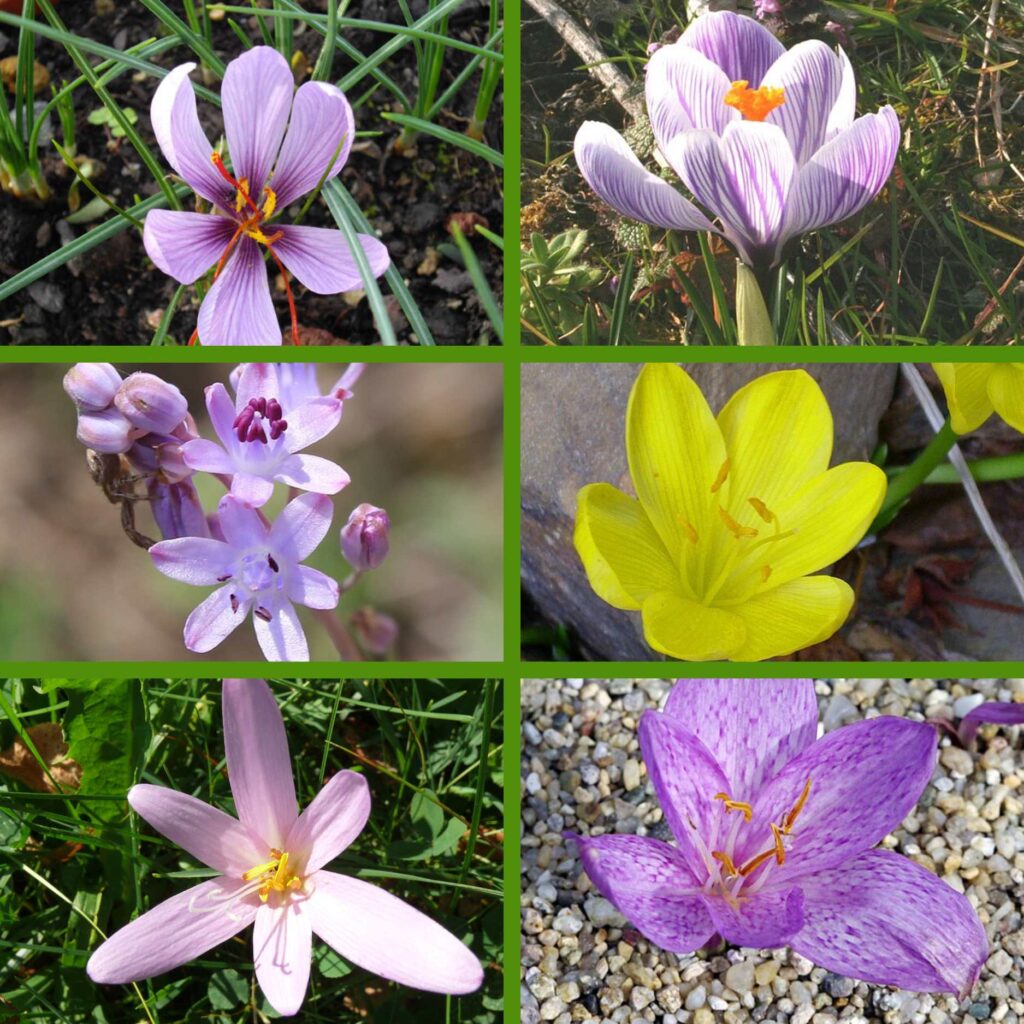
THE PLAYERS IN THE CRIMSON THREAD TRAP
This isn’t just a two-way confusion. There are multiple autumn-blooming plants with purple or yellow flowers that get mistaken for Saffron:
THE PRIZE:
- Saffron Crocus (Crocus sativus) – The real deal. Edible, medicinal, valuable.
THE KILLERS:
- Autumn Crocus / Naked Lady (Colchicum autumnale) – FATAL. Contains colchicine, causes organ failure.
- Striped Naked Lady (Colchicum variegatum) – FATAL. Same deadly compound, striped petals.
THE IRRITANTS (Not fatal but will ruin your day):
- Winter Daffodil / Lily-of-the-Field (Sternbergia lutea) – Yellow flowers, causes nausea and vomiting.
- Autumn Squill (Prospero autumnale) – Star-shaped purple flowers on spikes, causes digestive upset.
- Silvery Crocus / Striped Crocus (Crocus biflorus) – Edible but worthless (no flavor), striped petals.
All bloom in autumn. All have similar flower shapes (except Squill). All can grow in similar locations. And that’s the problem.
THE QUICK-REFERENCE COMPARISON
| Plant | STAMENS | STIGMAS | FLOWER FORM | LEAVES | STATUS |
|---|---|---|---|---|---|
| SAFFRON CROCUS | 3 yellow | 3 LONG RED threads | Cup-shaped, purple | Present with flower | SAFE – The Prize |
| AUTUMN CROCUS | 6 yellow | Short, pale/white | Cup-shaped, purple/pink | ABSENT – “naked stem” | FATAL |
| STRIPED NAKED LADY | 6 yellow | Short, pale | Cup with stripes | ABSENT – “naked stem” | FATAL |
| WINTER DAFFODIL | 6 yellow | Short, yellow | Funnel-shaped, YELLOW | Present with flower | Causes nausea |
| AUTUMN SQUILL | 6 with dark/black anthers | N/A | STAR-shaped on SPIKE | Grass-like, present | Irritant |
| SILVERY CROCUS | 3 yellow | Short, yellow/white | Cup with STRIPES | Present with flower | Edible but worthless |
THE RULE OF THREE (Your Life-Saving Math)
Here’s the single most important identification rule for this group:
Count the stamens (the yellow “legs” inside the flower).
- 3 stamens = Crocus species (may be safe)
- 6 stamens = Colchicum (DEADLY) or Sternbergia (will make you sick)
If you count six stamens, STOP. Do not harvest. It is NOT Saffron.
But don’t stop at stamen count – you need multiple identification points because some Crocus species (like Silvery Crocus) are edible but not valuable. You want TRUE Saffron.
THE DEFINITIVE SAFFRON IDENTIFICATION
To positively identify TRUE Saffron Crocus:
TEST 1: The Stamen Count (CRITICAL)
- Look inside the flower
- Count the yellow stamens (the “legs” with pollen on top)
- MUST have exactly 3 yellow stamens
- If you count 6, it’s toxic. Stop immediately.
TEST 2: The Crimson Thread (THE SIGNATURE)
- Look at the stigmas (the reproductive parts in the center)
- True Saffron has 3 LONG, VIVID CRIMSON-RED threads
- These threads are so long they often droop outside the petals
- They’re bright red-orange, not pale, not yellow, not white
- No red threads = Not Saffron
TEST 3: The Foliage Check
- True Saffron blooms WITH its leaves present
- Leaves are narrow, grass-like, dark green
- They emerge at the same time as or before the flowers
- If the flower is on a “naked” stem with NO leaves = Autumn Crocus (DEADLY)
TEST 4: The Flower Geometry
- True Saffron flowers are cup-shaped
- 6 purple petals (sometimes lilac or violet)
- One flower per stem
- Cup opens upward, not star-shaped
TEST 5: The Bloom Time
- True Saffron blooms late October through November (depending on climate)
- If blooming in spring, it’s a different (spring) Crocus species
- If blooming late summer/early autumn, could be Autumn Crocus (deadly)
ALL FIVE TESTS MUST PASS. If even one test fails, it’s not True Saffron.
AUTUMN CROCUS / NAKED LADY (Colchicum autumnale) – The Assassin
Primary Identification:
- Stamens: SIX yellow stamens (this is your first red flag)
- Stigmas: Short, pale, white or yellowish (NOT long red threads)
- Flower: Cup-shaped, purple to pink, similar size to Saffron
- Leaves: ABSENT when flowering – this is why it’s called “Naked Lady.” The leaves don’t appear until spring, months after flowering.
- Bloom time: Late summer through early autumn (August-October)
- Height: 4-8 inches
How It Kills You:
Autumn Crocus contains colchicine, a cellular poison that:
- Inhibits cell division throughout the body
- Causes multi-organ failure
- Has NO ANTIDOTE
- Symptoms can be delayed 2-6 hours after ingestion, making treatment difficult
- Death can occur days later from organ failure
Symptoms of colchicine poisoning:
- Severe burning in mouth and throat
- Intense abdominal pain, bloody diarrhea, vomiting
- Kidney failure, liver failure
- Bone marrow suppression
- Respiratory failure
- Cardiac arrest
Fatal dose: Very small. Even a few flowers can be lethal.
The Key Difference from Saffron:
- SIX stamens (Saffron has 3)
- NO leaves present when flowering (Saffron has leaves)
- Short pale stigmas (Saffron has long red threads)
The Deadly Confusion:
People see purple autumn flowers, assume it’s Saffron, harvest the stamens (yellow) thinking they’re getting saffron threads. They’re not harvesting the stigmas (which would be the wrong part anyway) – they’re harvesting colchicine-laden pollen.
WINTER DAFFODIL (Sternbergia lutea) – The Nauseant
Primary Identification:
- Stamens: SIX yellow stamens
- Stigmas: Short, yellow
- Flower: Funnel-shaped, BRIGHT YELLOW (not purple)
- Leaves: Dark green, strap-like, present with flower
- Bloom time: Late summer to autumn
Why It’s Confusing:
It’s not – Winter Daffodil is YELLOW, not purple. But people see it growing among other autumn bulbs and assume “autumn crocus” means “edible.” It’s not edible.
Toxicity:
- Not fatal but causes severe nausea, vomiting, and diarrhea
- Contains alkaloids that irritate the digestive system
- All parts are toxic
The Key Difference:
It’s yellow. Saffron is purple. If you can’t tell yellow from purple, you have bigger problems than plant identification.
AUTUMN SQUILL (Prospero autumnale) – The Irritant
Primary Identification:
- Stamens: SIX, with dark or blackish anthers (pollen tips)
- Flower: STAR-SHAPED, NOT cup-shaped
- Flower arrangement: Multiple small purple stars on a SPIKE
- Leaves: Thin, grass-like, present
- Bloom time: Late summer to autumn
Why It’s Confusing:
From a distance, a field of Autumn Squill looks purple and autumn-blooming. Up close, the star-shaped flowers on spikes are completely different from cup-shaped Saffron.
Toxicity:
- Causes digestive upset (nausea, vomiting, diarrhea)
- Not typically fatal but unpleasant
- Contains irritant compounds
The Key Difference:
Flower shape. Saffron is a cup. Squill is a spike of stars. If the flowers are star-shaped and clustered, it’s not Saffron.
SILVERY CROCUS (Crocus biflorus) – The Decoy
Primary Identification:
- Stamens: THREE yellow stamens (passes the first test!)
- Stigmas: Short, yellow or white (FAILS the red thread test)
- Flower: Cup-shaped with PURPLE STRIPES on white or lilac background
- Leaves: Grass-like, present with flowers
- Bloom time: Late winter to early spring (NOT autumn)
Why It’s Confusing:
It has 3 stamens like Saffron. It’s a Crocus. But the stigmas are short and NOT crimson red.
Is It Dangerous?
No – Silvery Crocus is edible. But it’s worthless. No flavor, no value. You could eat it and be fine, but you’d be disappointed if you were expecting Saffron.
The Key Difference:
- Stigmas are short and yellow/white (NOT long and red)
- Flowers are often striped (Saffron is solid purple)
- Blooms in spring, not autumn
THE IDENTIFICATION PROTOCOL: Step-by-Step
When you encounter purple autumn flowers you think might be Saffron:
STEP 1: Check the Leaves
- Are there grass-like leaves present? → Possible Saffron, proceed
- Is the flower on a bare “naked” stem? → Autumn Crocus (DEADLY), ABORT
STEP 2: Count the Stamens
- Look inside the flower
- Count the yellow “legs”
- 3 stamens? → Might be Saffron, proceed
- 6 stamens? → Toxic or irritant, ABORT
STEP 3: Examine the Stigmas (THE CRITICAL TEST)
- Look at the center reproductive parts
- 3 long, vivid crimson-red threads drooping out? → TRUE SAFFRON
- Short, pale, yellow, or white stigmas? → NOT Saffron, leave it
STEP 4: Check the Flower Shape
- Cup-shaped, one flower per stem? → Good for Saffron
- Star-shaped on a spike? → Autumn Squill, not Saffron
- Funnel-shaped and yellow? → Winter Daffodil, not Saffron
STEP 5: Verify Bloom Time
- Late October/November? → Correct for Saffron
- August/September? → Could be Autumn Crocus (deadly)
IF ALL TESTS PASS: You probably have True Saffron. Harvest only the red stigmas.
IF ANY TEST FAILS: It’s not Saffron. Leave it alone.
WHY PEOPLE DIE IN THE CRIMSON THREAD TRAP
Fatal Mistake #1: “It’s Purple and Autumn, Must Be Saffron”
Someone sees purple autumn flowers. They’ve heard Saffron blooms in autumn and is purple. They harvest it without checking for leaves or counting stamens. It’s Autumn Crocus. They use it in cooking. Days later, they die from organ failure.
Lesson: Color and season aren’t enough. Use the full identification protocol.
Fatal Mistake #2: “I’ll Harvest a Little to Test”
Someone isn’t sure if it’s Saffron. They harvest a small amount “just to try.” Even a small amount of Autumn Crocus can be fatal.
Lesson: Don’t “test” unknown plants by eating them. Positive ID first, harvest second.
Fatal Mistake #3: “The Stamens Look Like Saffron Threads”
Someone harvests the yellow stamens thinking they’re saffron. Saffron is the RED STIGMAS, not the yellow stamens. They’ve just harvested poison.
Lesson: Know what part to harvest. Saffron = red stigmas. Everything else = wrong.
HARVESTING TRUE SAFFRON (If You’re Certain)
If you’ve positively identified True Saffron Crocus:
What to harvest:
- ONLY the 3 crimson-red stigmas (the threads)
- NOT the yellow stamens
- NOT the petals
- NOT any other part
How to harvest:
- Gently pluck the 3 red threads from the center
- Do this in the morning after dew dries
- Handle gently – they’re delicate
How to dry:
- Lay threads on paper in a dry, dark place
- Air dry for several days
- Store in an airtight container away from light
- Properly dried saffron keeps for years
Yield reality:
- It takes about 150-200 flowers to get 1 gram of dried saffron
- This is why it’s so expensive
- This is also why people are tempted to take shortcuts (and why deaths happen)
THE VISUAL MEMORY AID
Memorize this rhyme:
“Three red threads for a heart of gold,
Six yellow legs for a death foretold.
If she’s naked and purple, let her stay,
If she’s grassy and red, you’ve saved the day.”
Translation:
- 3 stamens + red stigmas + leaves present = Saffron (safe)
- 6 stamens = Toxic
- Naked stem (no leaves) = Autumn Crocus (deadly)
FINAL THOUGHTS: Is It Worth the Risk?
True Saffron is expensive for a reason – it’s labor-intensive to harvest and easy to confuse with deadly plants.
Should you forage wild Saffron?
Arguments FOR:
- It’s valuable
- It’s beautiful
- Historical and cultural connection
- Identification is straightforward IF you know what to look for
Arguments AGAINST:
- The look-alikes are FATAL
- A single counting error can kill you
- Saffron is commercially available (expensive but safe)
- The risk-to-reward ratio is questionable
My take: If you want Saffron, buy it from a reputable source or grow it yourself in a controlled garden where you know exactly what’s planted. Foraging wild autumn bulbs is expert-level work with fatal consequences for mistakes.
This is one area where I genuinely think the risk isn’t worth it for most people. No spice, no matter how delicious or expensive, is worth dying for.
Learn the identification. Memorize the differences. But seriously consider whether you want to bet your life on counting to three correctly.
For individual plant profiles, see the Flora Archive. For detailed toxicity information on Autumn Crocus, visit the Poison Index.