
When Spring Greens Turn Deadly
The Wild Ramps Identification Challenge
Picture this: It’s early spring. You’re in the woods, excited to find the first wild greens of the season. You see broad, green leaves emerging from the forest floor. “Ramps!” you think – that prized wild leek that chefs pay a premium for. You harvest a basketful, sauté them in butter, and sit down to enjoy your foraged feast.
Except they weren’t ramps. They were False Hellebore or Lily of the Valley. Within hours, you’re experiencing cardiac arrhythmia, respiratory distress, and violent vomiting. You might not survive.
This is The Emerald Deception – where three plants that look nearly identical when young have wildly different outcomes. One is delicious. Two will kill you.
THE STAKES
Wild Ramps (Allium tricoccum), also called wild leeks, are one of the most sought-after wild foods in North America. They’re delicious, nutritious, and herald the beginning of foraging season. Chefs love them. Foragers love them. They taste like garlic and onions had a baby and that baby was delicious.
False Hellebore (Veratrum viride) causes severe vomiting, cardiac arrest, and respiratory failure. There is no antidote. Deaths are rare only because the violent vomiting usually expels most of the toxin before it can kill you.
Lily of the Valley (Convallaria majalis) contains cardiac glycosides similar to Digitalis (foxglove). It causes heart arrhythmias, seizures, and can be fatal. Also no antidote.
All three emerge in early spring. All three have broad, green leaves. All three grow in similar woodland habitats. And people confuse them every single year.
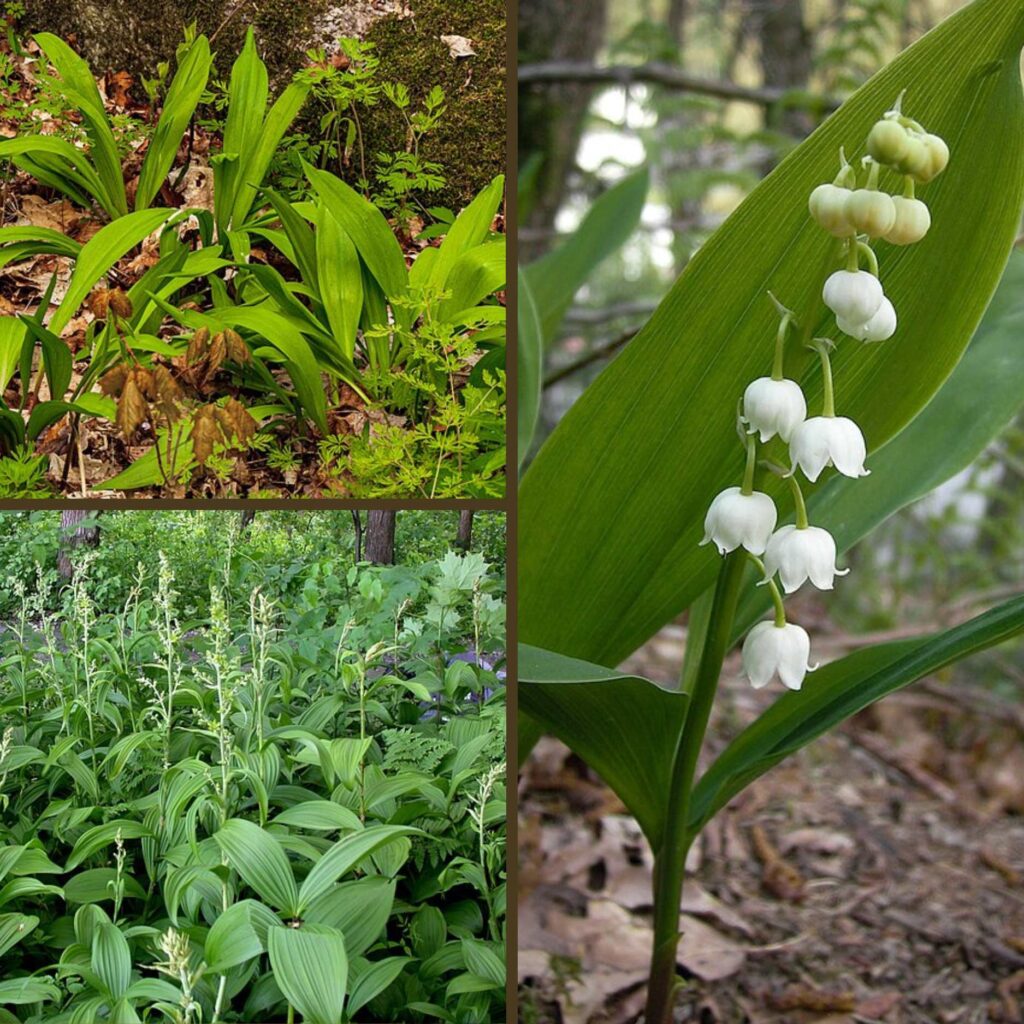
THE THREE PLAYERS
THE PRIZE:
- Wild Ramps / Wild Leeks (Allium tricoccum) – Edible, delicious, prized culinary wild food
THE KILLERS:
- False Hellebore (Veratrum viride) – Causes violent vomiting, cardiac issues, respiratory failure
- Lily of the Valley (Convallaria majalis) – Contains cardiac poisons, causes heart arrhythmias, potentially fatal
All three are perennial plants that emerge in early spring woodlands. The young leaves look similar. But the consequences of confusion are severe.
THE QUICK-REFERENCE COMPARISON
| Feature | WILD RAMPS | FALSE HELLEBORE | LILY OF THE VALLEY |
|---|---|---|---|
| SCENT | STRONG GARLIC/ONION | None or slightly unpleasant | None or slightly sweet |
| LEAVES | Smooth, flat, 1-3 broad leaves | PLEATED/RIBBED “accordion” texture | Smooth, rubbery, often in pairs |
| STEM BASE | Purple/reddish, often visible | Green, thick, emerging from pleated base | Green, not purple |
| ROOTS | White bulb with hairy roots | Thick rhizome, no bulb | Spreading rhizome, no bulb |
| SEEDS/FRUIT | Glossy BLACK seeds on stalk (late summer) | Green winged seed capsules | RED/ORANGE BERRIES (poisonous) |
| HABITAT | Rich woodland soil, often in patches | Wet woods, seeps, stream edges | Gardens, woodland edges (often escaped ornamental) |
| STATUS | EDIBLE – The Prize | TOXIC – Respiratory/cardiac toxin | TOXIC – Cardiac poison |
THE GARLIC TEST (Your First and Most Important Line of Defense)
Here’s the rule that will save your life:
If it doesn’t smell like garlic or onions when you crush or scratch a leaf, IT’S NOT RAMPS. Don’t harvest it.
This single test eliminates both deadly look-alikes:
- Wild Ramps smell STRONGLY of garlic/onions
- False Hellebore has no garlic smell (or smells slightly unpleasant)
- Lily of the Valley has no garlic smell (or smells slightly sweet/floral)
ALWAYS smell test BEFORE you harvest. Every. Single. Time.
Don’t trust your memory. Don’t assume. Don’t get lazy. Scratch and sniff every plant.
WILD RAMPS (Allium tricoccum) – The Prize
Primary Identification:
THE SCENT (CRITICAL):
- Crush or scratch a leaf
- STRONG, unmistakable garlic and onion smell
- The smell should make your eyes water if you get close enough
- If there’s ANY doubt about the smell, don’t harvest
THE LEAVES:
- 1-3 broad, smooth leaves per plant
- Lance-shaped to elliptical
- Smooth texture, NOT pleated or ribbed
- Medium to dark green
- Often shiny
- Emerge directly from underground bulb
THE STEM BASE:
- Purple, reddish, or burgundy coloring at the base
- This purple color extends from the bulb up into the lower leaf stems
- This is a KEY identification feature
THE BULB:
- White, elongated bulb underground
- Similar to a small onion or shallot
- Thin white roots extending down
- Papery outer layers (like an onion)
THE FLOWERS (late spring):
- Appear AFTER the leaves die back
- White, round cluster (umbel) on a leafless stalk
- Smell like onions
THE SEEDS (late summer):
- Glossy, jet-BLACK seeds
- Often called “Black Pearls”
- Appear on naked stalks after flowers
- This is a great way to mark ramp patches for next spring
HABITAT:
- Rich, moist woodland soil
- Often on north-facing slopes
- Grow in patches (sometimes large colonies)
- Found with spring ephemeral wildflowers
- Eastern North America (Appalachians especially)
TRADITIONAL USES:
Wild Ramps are a traditional spring tonic and food source, especially in Appalachian culture.
Culinary:
- Entire plant is edible (leaves, stems, bulbs)
- Taste like garlic + onions + leeks combined
- Used fresh in cooking, pickling, or preserving
- Sautéed, grilled, made into pesto
- Traditional spring festival food
Nutritional:
- High in vitamins A and C
- Minerals including iron and selenium
- Considered a “spring tonic” to revitalize after winter
Harvest Guidelines:
- Take ONLY the leaves if the patch is small (leave bulbs to regrow)
- If harvesting bulbs, take no more than 10% of a patch
- Ramps are slow-growing – overharvesting is a serious problem
- Some areas have banned or restricted ramps harvesting due to decline
- Sustainable harvest is critical for future seasons
FALSE HELLEBORE (Veratrum viride) – The Choker
Primary Identification:
THE SCENT:
- NO garlic smell
- May smell slightly unpleasant or “green”
- Some people report a faintly acrid smell
- Definitely NOT oniony
THE LEAVES (THE GIVEAWAY):
- DEEPLY PLEATED with parallel ridges
- Looks like an accordion or corrugated cardboard
- This pleating is the DIAGNOSTIC feature
- Leaves are broader than ramps, often clasping the stem
- Emerge tightly rolled, then unfold to show pleating
THE STEM:
- Thick, robust, green
- NO purple coloring at base
- Often hairy when young
THE ROOT:
- Thick, fleshy rhizome
- NOT a bulb
- No onion-like structure
THE FLOWERS (summer):
- Tall spike of greenish-yellow flowers
- Appears much later than ramps flower
HABITAT:
- Wet woods, stream sides, seeps
- Areas with consistent moisture
- Often in somewhat wetter areas than ramps
HOW IT POISONS YOU:
False Hellebore contains veratrum alkaloids that:
- Cause VIOLENT vomiting and diarrhea (often immediate)
- Slow heart rate dangerously (bradycardia)
- Lower blood pressure
- Cause burning sensation in mouth and throat
- Can cause respiratory depression
- Can be fatal, though deaths are rare because vomiting expels much of the toxin
Symptoms appear quickly:
- Burning mouth and throat within minutes
- Excessive salivation
- Violent, persistent vomiting
- Abdominal pain
- Slowed heartbeat
- Difficulty breathing
- Weakness, dizziness
The irony: The violent vomiting False Hellebore causes is often what saves people – they throw up the plant before enough toxin is absorbed to be fatal. But it’s still an absolutely miserable experience requiring hospitalization.
The Key Difference from Ramps:
- NO garlic smell (this alone should stop you)
- PLEATED leaves (ramps are smooth)
- NO purple at stem base (ramps have purple/red)
- NO bulb (ramps have a distinct bulb)
LILY OF THE VALLEY (Convallaria majalis) – The Cardiac Assassin
Primary Identification:
THE SCENT:
- NO garlic smell
- Flowers (when present) smell sweet and floral
- Leaves have no strong scent or slightly sweet
THE LEAVES:
- Smooth, NOT pleated (similar to ramps in this way)
- Often appear in PAIRS from a single point
- Rubbery texture – thicker and tougher than ramps
- Oval to lance-shaped
- Often darker green than ramps
- Parallel veins (like most lilies)
THE STEM BASE:
- Green, NOT purple or reddish
- No color variation
THE ROOT:
- Spreading rhizome (underground stem)
- NO bulb
- Forms dense colonies via underground spread
THE FLOWERS (spring):
- Distinctive WHITE, bell-shaped flowers
- Hanging downward like tiny bells
- Very fragrant (sweet smell)
- One-sided raceme (flowers all on one side of stem)
THE BERRIES (late summer/fall):
- BRIGHT RED or ORANGE berries
- Round, glossy
- Extremely toxic
- Often eaten by children who don’t know better
HABITAT:
- Woodland edges, gardens
- Often an escaped ornamental
- Forms dense patches
- Spreads aggressively
HOW IT POISONS YOU:
Lily of the Valley contains cardiac glycosides (similar to Digitalis/foxglove) that:
- Disrupt heart rhythm (arrhythmia)
- Can cause heart attack
- Cause nausea, vomiting, diarrhea
- Cause confusion, blurred vision, visual disturbances (seeing yellow halos)
- Can be fatal
Symptoms:
- Nausea and vomiting
- Diarrhea
- Irregular or slow heartbeat
- Confusion, drowsiness
- Blurred vision or “yellow vision”
- Seizures (in severe cases)
- Cardiac arrest
ALL parts are toxic: leaves, flowers, berries, roots. Even the water in a vase with Lily of the Valley flowers is poisonous.
The Key Difference from Ramps:
- NO garlic smell (critical test)
- NO purple at stem base (ramps have this)
- Rubbery texture (ramps are thinner, more delicate)
- Often in pairs (ramps usually 1-3 leaves per plant, not paired)
- RED BERRIES later (ramps have black seeds)
THE IDENTIFICATION PROTOCOL: Step-by-Step
When you encounter broad green leaves in early spring woods:
STEP 1: The Smell Test (MANDATORY – DO THIS FIRST)
- Scratch or crush a small piece of leaf
- STRONG garlic/onion smell? → Might be ramps, proceed to next test
- NO garlic smell or other smell? → NOT ramps, STOP, do not harvest
This single test eliminates both deadly look-alikes. If you remember nothing else, remember: No garlic smell = Not ramps = Don’t eat it.
STEP 2: The Texture Test
- Run your fingers along the leaf surface
- Smooth and flat? → Could be ramps or Lily of the Valley, continue testing
- Pleated/ribbed like an accordion? → False Hellebore, STOP
STEP 3: The Stem Base Color Check
- Look at where the leaves emerge from the ground
- Purple, reddish, or burgundy color? → Good sign for ramps
- Green with no purple? → Not ramps, likely Lily of the Valley
STEP 4: The Bulb Check
- Gently dig around one plant (if you’re still confident after steps 1-3)
- White bulb with papery skin like a small onion? → Ramps
- Thick rhizome with no bulb? → Not ramps, don’t harvest
STEP 5: The Habitat Double-Check
- Rich, well-drained woodland soil? → Good for ramps
- Very wet, seepy area? → More likely False Hellebore
- Garden edge or ornamental setting? → Possibly Lily of the Valley (escaped ornamental)
IF ALL TESTS PASS: You probably have ramps. Harvest sustainably.
IF ANY TEST FAILS: It’s not ramps. Leave it alone.
WHY PEOPLE GET POISONED IN THE EMERALD DECEPTION
Fatal Mistake #1: “I’ve Harvested Ramps Before, I Know What They Look Like”
Someone has foraged ramps in the past. They see broad green leaves in spring and assume “ramps.” They don’t smell test because they’re confident. It’s False Hellebore or Lily of the Valley. They get very sick or die.
Lesson: ALWAYS smell test. Every plant. Every time. Confidence kills.
Fatal Mistake #2: “They’re Growing in the Same Place as Ramps”
Someone finds a patch of ramps. Next to it are similar-looking plants. They harvest everything without checking each individual plant. They mix deadly look-alikes into their ramps harvest.
Lesson: Test EACH plant individually. Look-alikes can grow right next to the real thing.
Fatal Mistake #3: “I’ll Just Harvest a Little Without Being Sure”
Someone isn’t certain but harvests a small amount “to try.” Even a small amount of False Hellebore or Lily of the Valley can cause serious poisoning.
Lesson: Positive ID BEFORE harvest. Never “test” by eating.
Fatal Mistake #4: Children and Berries
A child sees bright red berries (Lily of the Valley) in late summer and eats them thinking they’re food. Cardiac poisoning follows.
Lesson: Teach children NEVER to eat wild berries or plants without adult approval. Those pretty red berries are deadly.
SUSTAINABLE RAMPS HARVESTING
If you’ve positively identified ramps and want to harvest:
The Problem:
Ramps are slow-growing. They can take 7-10 years to reach maturity from seed. Overharvesting has caused serious population declines in some areas.
Sustainable Guidelines:
If harvesting LEAVES only:
- Take 1 leaf per plant maximum
- Leave the bulb and remaining leaves
- The plant can regrow
- This is the most sustainable method
If harvesting BULBS:
- Only harvest from large, healthy patches
- Take no more than 5-10% of the patch
- Spread your harvest across the patch, don’t clear one area
- Leave smaller, younger plants
- Some areas have banned bulb harvest entirely – check local regulations
Best Practices:
- Harvest in patches with 50+ plants minimum
- Take only what you’ll actually use
- Consider transplanting some to your property instead of wild harvesting
- Mark patches in late summer (when black seeds are visible) for spring harvest
- Report significant patches to conservation groups for monitoring
THE MEMORY AID
Memorize this rhyme:
“If it doesn’t smell like onions strong,
Leave it be – you could be wrong.
Pleats mean poison, smooth means maybe,
Red means deadly, black means gravy.
Purple stems and garlic breath –
That’s the ramp that’s safe from death.”
Translation:
- Garlic smell = essential
- Pleated leaves = False Hellebore (poison)
- Smooth leaves = could be ramps or Lily of the Valley (need more tests)
- Red berries = Lily of the Valley (deadly)
- Black seeds = Ramps (safe)
- Purple stem base + garlic smell = Ramps (the prize)
WHAT TO DO IF POISONING IS SUSPECTED
False Hellebore or Lily of the Valley poisoning:
- Call 911 immediately – especially for Lily of the Valley (cardiac effects)
- Call Poison Control: 1-800-222-1222
- Do NOT induce vomiting unless directed (False Hellebore usually causes vomiting on its own)
- Bring a sample of the plant if possible
- Note time of ingestion and amount consumed if known
For Lily of the Valley specifically:
- Cardiac monitoring is essential
- May need heart medications to control arrhythmia
- This is a serious medical emergency
For False Hellebore:
- Expect violent vomiting and diarrhea
- Dehydration is a major concern
- Cardiac monitoring also needed (can cause bradycardia)
- IV fluids usually required
FINAL THOUGHTS: Is Ramps Foraging Worth the Risk?
Arguments FOR:
- Ramps are delicious and prized
- Identification is straightforward with the smell test
- Cultural and culinary significance
- A true sign of spring
Arguments AGAINST:
- The look-alikes are seriously toxic
- Overharvesting is a real conservation problem
- One lazy moment (not smell testing) can hospitalize you
- Sustainable harvest requires restraint many foragers lack
My take:
The smell test makes ramps relatively safe to identify – IF you use it every time. The problem is when people get overconfident and skip that crucial step.
If you want to forage ramps:
- Learn all three plants at multiple life stages
- NEVER skip the smell test
- When in doubt, leave it out
- Harvest sustainably or not at all
- Consider growing them in your garden instead
The Emerald Deception is real, but it’s also very preventable. The deadly look-alikes don’t smell like garlic. Ramps do. That’s your safety net. Use it.
For individual plant profiles, see the Flora Archive. For detailed toxicity information on False Hellebore and Lily of the Valley, visit the Poison Index.